Showing posts with label US Presidents. Show all posts

May 24, 2012

"Lincoln's Storytelling Propensity"

This one comes from the Southern Banner of Athens, GA on March 11, 1863:

Russell, of the Times gives the following illustration, which he himself witnessed, of Lincoln's story-telling propensity:

Mr. Bates remonstrating apparently against the appointment of some indifferent lawyer to a place of judicial importance, the President interposed with "Come now Bates, he's not half as bad as you think.  Besides that, I must tell you he did me a good turn long ago.--When I took to the law, I was going to court one morning, with some ten or twelve miles of bad road before me, and had no horse.  The Judge overtook me in his wagon.  "Hello, Lincoln! are you not going to the Court House? Come and I'll give you a seat."  Well, I got in and the Judge went on reading his papers.  Presently the wagon struck a stump on one side of the road; then it hopped off to the other.--I looked out, and I saw the driver was jerking from side to side in his seat, so says I, "Judge, I think your coach man has been taking a little drop too much this morning."  "Well, I declare, Lincoln," said he, "I should not much wonder if you are right, for he has nearly upset me half a dozen times since starting."  So putting his head out the window, he shouted, "Why you infernal scoundrel, you are drunk;"  Upon which, pulling up his horse and turning round with great gravity, the coachman said, "By gorra! that's the first rightful decision you have given for the last twelve-month."

November 28, 2011

Wm. H. Harrison and the 'White Slavery Slander'

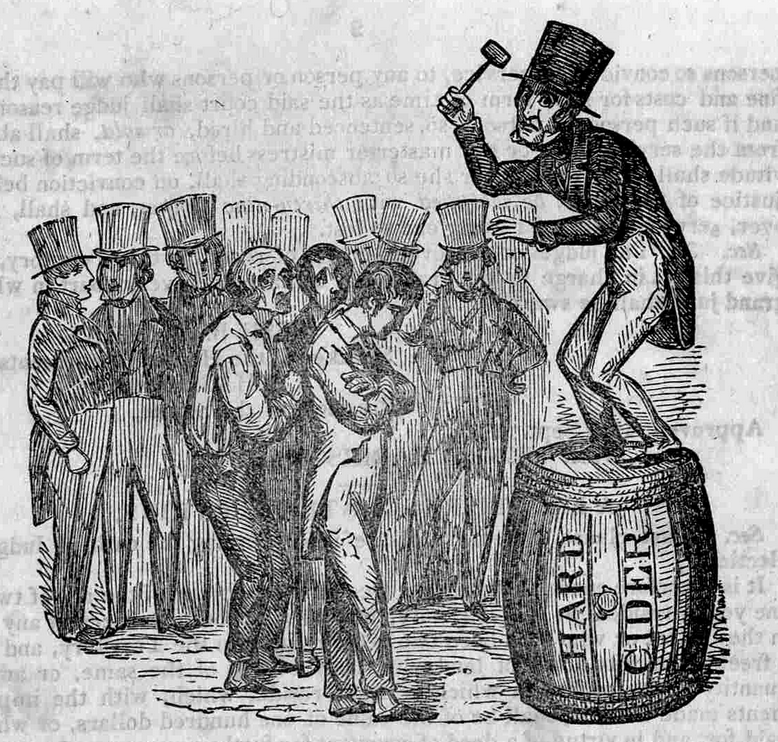
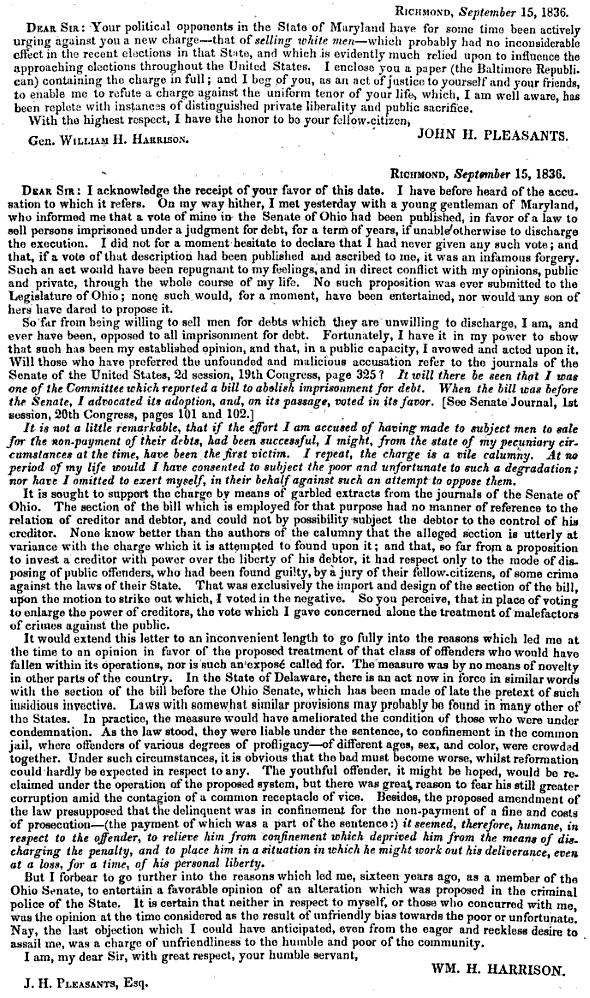
William Henry Harrison's political opponents during the 1836 and 1840 Presidential campaigns accused him of supporting debt bondage, or "white slavery," laws while serving as Governor of Indiana (1807) and in the Ohio State Senate (1820).  Herein are a leaflet which promotes this claim, and a letter written by Harrison refuting it.


The laws in question legalized forced labor as a means for criminals to work off fines they could not otherwise afford to pay. The leaflet argues that the forced labor is not levied as a consequence of their crime, but as a consequence of the criminal's poverty.  In this way, the law effectively permits debt bondage.  And it makes this argument in an entertainingly over-the-top way:
"Did our fathers of the Revolution fight for MONEY?  On the contrary, did they not pour out their money and their blood also like water for LIBERTY?  Liberty was the watchword and Liberty the prize of a bloody and protracted civil war.  Liberty was achieved and behold a second generation has not passed away, before some of the children of Revolutionary Fathers place this blood bought prize on a level with MONEY!"

According to Harrison, the reasoning behind the law(s) were as follows:
...the proposed amendment of the law presupposed that the delinquent was in confinement for the non-payment of a fine and costs of prosecution (the payment of which was part of the sentence): it seemed, therefore, humane, in respect to the offender, to relieve him from confinement which deprived him from the means of discharging the penalty, and to place him in a situation in which he might work out his deliverance, even at a loss, for a time, of his personal liberty.

Full transcripts of both documents follow after the jump. The leaflet dates from the 1840 campaign, while the letter from Harrison was written in 1836.  The leaflet is from the LoC Printed Ephemera collection, while the letter can be found on google books, published in pro-Harrison campaign literature from 1840 which claims to compare the views of Harrison and Van Buren (the Presidential candidates in 1840).  


November 22, 2011

Invasion of the South, April 6, 1861

The following article comes from the New York Herald, on Monday, April 8, 1861, four days before the Battle of Fort Sumter, the conventional beginning of the Civil War.  The article mentions that ships left New York on the previous Saturday, which would have been April 6, 1861.

Invasion of the South--The Inauguration of Civil War 
By order of the federal government, on Saturday ships of war and transports, with troops, provisions, stores, ammunition and arms, large and small; tools, sandbags, spades and other siege tools; stalls for horses, boats, boat howitzers for landing, and "all the circumstance of war," cleared from [New York] with sealed orders, for parts unknown.  The city was like a camp, and the excitement was intense.  Some of the officers of the army, knowing the bloody mission on which the Powhatan and Atlantic are sent, resigned rather than mingle in the fratricidal conflict.  The ships which have sailed are but the van; others are preparing to follow them, not only from this port, but from the Navy Yard of Charlestown, Massachusetts, where there is the same warlike activity as at Brooklyn and New York. 
It is thus evident that a bloody civil war is resolved upon by Mr. Lincoln and his Cabinet.  After long hesitation, the President has screwed his courage to the fighting point.  At what precise spot he intends to commence hostilities or to provoke them--whether at Charleston, Pensacola, the mouths of the Mississippi or in Texas, where there is an evident design to excite "domestic insurrection," or at all of these places together--does not yet appear; but a few days will unfold the mystery. 
To Mr. Lincoln, his Cabinet and the leaders of the republican party three courses are open--first, to yield to the Confederate States and to all the slaveholding communities their just rights as coequal partners in the Union, which would have had the effect of healing the breach and reuniting the sections; second, to permit a peaceable and bloodless separation, either in the hope of reunion at a future day, or at least of a friendly alliance for mutual defense against foreign foes, and for the establishment of commercial relations, which, if not specifically favoring the North, would at least not discriminate against her; and third, to wage a war of subjugation against seven sovereign States, which will be ultimately extended to fifteen, to compel them to submit to the authority of the government at Washington, and to pay tribute to it, whether they are represented in its Congress or not, in contravention to the great principle for which the colonies fought and conquered the mother country in the Revolution of 1776--the principle that "without representation there can be no taxation." 
The first of the three courses was the best, and would have been that of a statesman.  The second is the next best course, because the most successful war could only lead to the same result after inflicting an amount of suffering and calamity upon the country at which the imagination is appalled.  As for now restoring the revolted States to the Union by war, that is the wildest chimera that ever entered the brain of man.  But it is probable that even if the Northern section should succeed in subduing the South (for that is the naked aspect of the war when stripped of all its disguise), the same favorable terms would not be obtained, certainly not the same entente cordiale so necessary to the future peace and prosperity of both sections, as could be secured by the peaceful arts of diplomacy and statesmanship, which seem to have been completely ignored at Washington.  The third course has been adopted, and that is unquestionably the worst of all.  If it fails, and that is very possible, it will be destructive to the prestige and to the interests of the North, to say nothing of the overwhelming expense and debt which it will entail upon the country, the many hearths it will leave desolate and the feelings of bitter eternal enmity which it will have engendered between two geographical sections separated by an imperceptible line. 
The pretence of carrying out the laws of this Union in the confederate States, enforcing the federal authority and collecting the revenue, is too transparent to deceive any person.  It has been clearly demonstrated that it is impossible to accomplish these objects without civil war of the most ferocious kind.  To make the attempt, therefore, is deliberately to commence a war whose end the present generation may not live to see, and whose disastrous effects will be such as to annihilate the accumulated wealth of the country at a blow, and throw back its progress half a century.  The real object of the war is not to collect revenue, nor to assert the authority of the federal government, nor to protect its property.  It is a war of propagandism--a war against the social institutions of fifteen States--a war to extirpate negro slavery, if not to exterminate slaveholders.  It is the irrepressible conflict predicted by Mr. Seward and Mr. Lincoln, and for which Garrison, Giddings and the blood-thirsty abolitionists of their fanatical party have been laboring for the last thirty years.  It is a revival of the struggle which took place two centuries ago in England between the Puritan Roundheads and the rest of the nation.  The vast majority of the people were against them, but by the military genius and iron will of Cromwell the fanatics were rendered successful for a time, after putting their king to death and deluging their native land with seas of blood.  But when their chieftain died, their cause died with him, showing that it had no root in the affections of the people, and that it was equally opposed to human nature and the freedom of man.  Hence, when Charles II, who had nothing personally to recommend him, was restored, he was "proclaimed with a pomp never before known."  A fleet conveyed him from Holland to the coast of Kent; for that republic had no sympathy with the fanaticism of the Puritan republic of England.  When Charles landed the cliffs of Dover were covered with thousands of gazers, among whom, says the historian Macaulay, "scarcely one could be found who was not weeping with delight.  The journey to London was a continued triumph.  The whole road to Rochester was bordered by booths and tents, and looked like an interminable fair.  Everywhere flags were flying, bells and music sounding, wine and ale flowing in rivers to the health of him whose return was the return of peace, of law, of freedom." 
That was the last of the Puritan faction in England.  They have never revived.  But their descendants here, the inheritors of their principles and their blood, now seek to inaugurate another civil war upon a question of morals, religion and social polity, in States over which they have not, and ought not to have, any control.  Like their ancestors in Great Britain, they are in a small minority, but by an accident and the divisions of the people they have contrived to get hold of the reins of government; they have the sword of the nation, and for the present its purse.  With this temporary power in their hands, they are preparing to embark in internecine strife, against the will of three-fourths of the people.  But whether they will be fortunate enough to find another Cromwell to lead them remains to be seen.  From our accounts the military talent of the army has espoused the side of the Southern confederacy.  The South, moreover, is united to a man when it comes to blow, while the North is divided, and will be rent asunder by still greater divisions as the war proceeds, if even insurrections and revolutions do not take place in several Northern States.  Soon the government will find itself in the position of the British government in the war of our first Revolution, only in a still greater degree.  There will be such a storm of opposition, together with a positive refusal to furnish the sinews of war, that the Lincoln administration will be compelled to succumb in disgrace, amidst the execrations of the people and the curses of mankind.  And that will be the end of the Puritanical faction in North America.


November 19, 2011

Interview with an Antebellum & Progressive Era Congressman

Galusha A. Grow was a member of the U.S. House of Representatives during the 32nd, 33rd, 34th, (1851-1863) and 56th (1894-1903) Congresses.  That is not a typo; he was re-elected to Congress after thirty years.  He also started his congressional career as a Democrat, but switched to the Republican party after the passage of the Kansas-Nebraska Act.  During the first years of the Civil War, Grow also served as Speaker of the House.  In this interview, prompted by his re-election in 1894, Grow discusses details of his childhood as well as his earlier years in Congress, including the physical altercation he had with Lawrence Keitt which led to a sectional brawl among several members on the House floor.  

From The Saint Paul Daily Globe on March 4, 1894:

CHAT WITH GALUSHA GROW 
HIS RETURN TO CONGRESS AFTER THIRTY YEARS 
STORY OF HIS EARLY LIFE
How He Became the Successor of David Wilmot -- Interesting Recollections of the Leading Statesmen and Orators of the Ante-Bellum Period -- Passage of the Homestead Laws. 
Correspondence of the Globe.
GLENWOOD, Pa., March 2.--An interview with the most affable of American statesmen, Galusha A. Grow, who at the end of an election for congressman-at-large in Pennsylvania returns to the United States house of representatives, is a matter of pleasure as well of interest.  With a courtesy equal to Chesterfield, a dignity and ease that made him memorable as speaker of the house during the stormy times of 1861-1862, he is at the same time as truly democratic as when he was a young and unknown attorney.  In Pauwell's great allegorical picture, exhibited in the Holland section at the Centennial, prominent among the great Americans stands the figure of Galusha A. Grow, who as the originator of the homestead bill, has been hailed abroad as one of the benefactors of mankind. 
On the opening day of the Thirty-second congress, in December, 1851, a tall, smooth-faced young man of twenty-seven, walked to the clerk's desk and took the oath of office.  Curious eyes closely scanned the new member's make-up, for he came to the house as the apparently unknown successor of a man of national repute, David Wilmot, whose proviso had occupied the attention of previous congresses to the almost total exclusion of other matters.  The young man's name was Galusha A. Grow, and he soon demonstrated that those who had selected him to succeed so notable a man had made no mistake in their choice.  He early became the leader of the courageous and brainy men who, during the exciting days preceding the war, waged unyielding battle against the demands of the slave power on the floor of the house, and the leadership which he gained at the outset of his congressional career, his great abilities and unswerving devotion to duty and the right easily enabled him to retain during the twelve years he remained in congress. 
There was no important measure introduced during his period of service that did not feel the influence of his voice and vote, while to his determination, persistence and farsightedness was due the final passage of the homestead act, with perhaps a single exception, the most important legislation of congress, and which has done more than all else to make the West so great and prosperous. 

November 16, 2011

Editorial on Democratic Party & Whig Party Politics, 1838

This comes from the Kentucky Gazette of Lexington, KY on April 5, 1838.   To show that the Whig party are unworthy of their votes, the author traces the origins of that party as beginning with the Federalist party, arguing that they are different in name only.   This articles includes denouncement of the politics of John Adams, John Quincy Adams, and Alexander Hamilton, argument against the chartering of a third national bank, argument against Henry Clay for President in the upcoming election, and discussion of strict versus broad interpretations of the U.S. Constitution.

My favorite part of the below address is this fable, which the author uses to illustrate how a broad interpretation of the Constitution's general welfare clause will be used to 'hack away' at citizen's liberties:

It has an excellent moral, that old fable of the woodman and the forest.  A certain woodman (it must have been in those early days of poetry when flowers spoke and trees reasoned)--a woodman one fine morning, humbly begged of the forest, that she would be so obliging as to give him some spare limb or other from one of her trees--quite a small one would answer his purpose--merely to make a handle for his axe.  The good tempered forest thoughtlessly agreed to his proposal; the axe handle was made; and the next day, the woodman having thus obtained the means of executing his project without further leave returned, and fell to work with so much effect, that in a few days the poor forest saw the noblest of her trees levelled with the ground, the death knell of the others, as one by one they sunk beneath the murderous axe, sounded hourly in her ears.  How bitterly then did she repent of her easy compliance!


The article has over ten footnotes that go along with it, but I had such a difficult time distinguishing symbols from smudges on the page, and then trouble figuring out which note corresponded with which symbol, so I left them out of my transcription.  Therefore, please see the original article (page 1 and page 2) to view the footnotes.


November 8, 2011

The Challenge of Reporting on Bleeding Kansas, 1856

I like these articles about the conflict in the Kansas Territory from the Tuesday, Sept 16, 1856, issue of the New York Tribune for several reasons, hardly the least of which is that they are highly entertaining to read. That is, if you enjoy reading antiquated insults aimed at politicians.  Another reason I like them is because they illustrate that people at the time were often confused about what was happening in Kansas, something I believe has persisted in historical treatments of the topic.  Although the author complains about the border-ruffian bias of the news reports coming out of Kansas, I think the free-state bias expressed in this article is relatively moderate and fair given its chronological proximity to the events at hand.


From the New-York Daily Tribune on Tuesday, September 16, 1856:
It would be absurd to look to the drunkard Atchison, to the drunkard Shannon, or to the drunken rabble of Missouri, or even to the miserable President Pierce, who, perhaps, can scarcely be held more accountable than they—it would be absurd to look to any of these as the really responsible parties for the atrocious crimes against both public and private rights, the rights of citizens as well as the ordinary rights of humanity, of which Kansas is now the scene.  Neither the ruffians of Missouri, nor President Pierce, heartless and soulless demagogue and doughface as he is, would have dared to venture, would have ever thought even of venturing upon such unheard-of atrocities, had they not been instigated to it, and encouraged and supported in it, by persons of vastly more social and political consequence and influence than themselves.  That which has been done is now doing in Kansas, is briefly this: A Missouri mob takes violent possession of the polls, elects a pretended Legislature, and through the medium of that pretended Legislature enacts a bloody and atrocious code; and that same mob are now in Kansas with arms and torches in their hands, murdering the Free-State men, burning down their towns and houses, and driving them, stripped of all their property, from the Territory, under pretense of enforcing order, sustaining the authority of the United States, and putting in execution the laws of the Territory! 
Now, admitting that the first violation of the rights of the people of Kansas, by driving them from the polls and returning as elected a body of the bogus legislators, was solely the idea and act of the Border Ruffians themselves, without any encouragement or instigation from Washington or elsewhere—which is more, we fear, than the truth of the facts will warrant—yet other persons, by upholding and sustaining as a legal body the bogus Legislature thus infamously imposed upon Kansas, and their infamous laws as a binding code, have made themselves the responsible parties for all the subsequent outrages.  And who are the parties who have thus taken upon themselves this terrible responsibility—a responsibility to which the people of these United States will most strictly hold them?  These responsible parties, these indorsers of the Missouri invaders and their bogus Legislature, are the Cabinet of President Pierce, the Border-Ruffian majority in the Senate of the United States, and, to a still greater degree than either of these, the Cincinnati Convention and the politicians who support the nominee and the platform of that Convention.  It is only the confidence of being sustained by, and the hope of giving pleasure and satisfaction to, these influential parties, that have emboldened the Border Ruffians of Missouri to enter upon the ferocious, bloody work in which they are now engaged.  They are but re-acting the part of the servants of Henry II., who, in the hope of pleasing their King and master, waylaid and murdered Thomas a Becket; and the politicians, to please and gratify whom murders and other outrages are now being perpetrated in Kansas, may rest assured that before they ever again can be recognized as Christians or political leaders, the same humble, barefooted penance which the proud and powerful Henry II. was obliged to pay at the shrine and grave of St. Thomas a Becket to purge his conscience of that murder, the people of the United States will force them to pay at the graves of the martyrs of Kansas. 
The Cabinet at Washington, the Senate of the United States, the Cincinnati Convention, and the politicians that support the Platform and the candidate of that Convention, will each and all, and every individual of them, be held responsible for the horrible deeds lately done and now being done in Kansas; but there are four individuals, all northern men and all doughfaces, upon whom the force of the public indignation may be expected to fall with a weight peculiarly crushing.  These four persons are, Marcy and Cushing of the Cabinet, Douglas of the Senate, and Buchanan, the nominee of the Cincinnati Convention—no longer (as he himself declares) the man James Buchanan, but a walking, writing, speaking automaton, to which the Cincinnati Platform serves as intellect and conscience, and which has neither wish, hope, intention, or sentiment beyond those embodied in that document. 
Pierce may be let off on the score of imbecility, natural or superinduced; but these four able men cannot set up the excuse of folly.  They have gone into this Kansas business with their eyes open; and, let them be assured, they will be held to a responsibility at which bolder men than they might well tremble. 
--------- 
Our readers have already been reminded that Missouri and the Border Ruffians lie directly between us and Kansas, so that the first tidings of all conflicts or outrages in that devoted Territory emanate from Pro-Slavery sources, and reach us through Pro-Slavery channels.  Even The Missouri Democrat forms no exception to this remark, since, though its correspondents mean to be fair and its editors just, yet their telegraphic news is mainly made up of the stories set afloat by the Ruffians in Kansas or hovering on her border.  Under such circumstances, we have no alternative but to publish the accounts as they reach us, fully believing that our dispatches and Missouri bulletins which are calculated to discredit the Free-State men, will in due time be corrected by more authentic advises, including the letters of our own correspondents.  It is hard to be obliged to give the falsehoods of the Ruffians ten or twelve days’ start of the truth, but we see no practicable alternative. 
The journals and politicians in vogue with the Ruffians pursue a different course.  They print the first Pro-Slavery bulletins, and carefully suppress those of the Free-State men; and when the former are proved false in any respect, they use this circumstance to discredit the true advices from Kansas and induce a belief that there is little or no trouble there—thus making the falsehoods or mistakes of their Missouri confederates do double duty.  Thus The New-London Star says: 
“Old Brown and young Brown, who were so badly ‘killed’ in Kansas lately, per telegraph, by the ‘Pro Slavery’ party have both turned up ‘alive.’ They were not in the ‘battle’ at all.  The people are beginning to appreciate these Kansas lies, and, as Dr. Olds said the Ohio Republican editor told him, he wouldn’t give a d---n a yard for them.” 
Now “Old Brown” and one or more of his sons were engaged in the defense of Osawattamie against a ten-fold force of Border Ruffians, who routed the Free-State men, killed several, wounded more, and sacked and burnt the town.  The victors reported that they had killed “Old Brown” and one of his sons; but it seems that they were mistaken—at least with regard to the former.  He probably lost his hat in fleeing across he Osage, which gave the Ruffians the impression that he had been shot and had sunk, leaving his hat floating on the stream.  His son, the last reports say, was killed, but the father appears to have been unaware of the fact when he wrote to his wife from Lawrence on the 2d inst.  No Free-State dispatch or letter has reported his death; yet The Star would fain improve this Border Ruffian mistake to the discredit even of the fact that there was a conflict at Osawattamie at all! 
--So The Albany Argus seizes on the fact that lawyer Phillips of Leavenworth, recently murdered in his own house for the crime of being a Free-State man, was in one dispatch termed a correspondent of The Tribune—a very natural mistake, since hundreds in Kansas and Western Missouri know that one of our Kansas correspondents is named Phillips, is a warm Free-State man, and has, in this discharge of his duties, spent considerable time in Leavenworth—to discredit all accounts of outrage and murder in Kansas—as if it made any difference, as to this, whether the Mr. Phillips killed by the Ruffians at Leavenworth were or were not our correspondent.  We exposed the error of the telegraphic dispatch on this point simultaneously with its appearance in the journals of the Atlantic States. 
--So Mr. Ely Moore (Indian Agent) took advantage of the fact that another Eli Moore had been reported guilty of an outrageous assault on a Free-State man in Kansas (see Investigating Committee's Report, page 963,) to deny most pompously that he had committed any such outrage, to assert that The Tribune had no correspondent stationed at Lecompton (where no known correspondent of this paper could live a week), and to assert that the Kansas correspondence of this and other Eastern papers was manufactured in their own offices! Comment would seem superfluous. 
--The Buchaneers are sweeping the votes of Missouri and all the South on the strength of what they are doing and confidently expected to do to make Kansas a Slave State.  We concede them the vote of every State south of Chesapeake Bay, knowing why they get them.  Now if they can make the North believe that there is no such region as Kansas, no effort to subjugate it to Slavery, and no violence, outrage or murder committed on its Free-State settlers, they may secure votes enough from the Free States to elect their men.  Let us see how they do it. 
--------- 
The Charleston Standard has a letter from Atchison, Kansas, which shows the purpose with which the invaders of that Territory from Carolina, Georgia and Missouri have entered upon the last foray against the Free-State settlers.  We quote: 
“We are ordered to march to-morrow, and I think will be stationed on the Nebraska line.  Reports have reached us to-day of a fight in that direction, in which fifty Abolitionists were killed and the rest driven back.  This is almost too good to be true.  
“Gov. Shannon has resigned (his successor not having arrived yet), and Hon. Woodson is now Governor pro tem.  By reliable information we hear that he has said hat, as soon as a sufficient force can be collected to warrant the move, he, as Governor, will issue a proclamation declaring the Territory in a state of insurrection, and take the field.  The United States troops are stationed at Lecompton to protect the Government property, but will not interfere in the fight.  Col.  Titus has not been killed, but was badly wounded, and a prisoner.  His ransom was obtained by the restoration of a piece of cannon, taken by the Palmetta Rifles at Lawrence.  Reinforcements are daily arriving, and I do not think 'twould be advisable for us to take the field with less than two thousand men.  We are very badly supplied with cannon, having only a few six-pounders, and the enemy have a greater number and larger pieces.  Our only chance will be to take their's from them.  
"We are regularly in for it now, and in a few days will actually be engaged in a civil war--which will, I presume, result in a dissolution of the Union." 
The writer clearly shows that the invaders of Kansas anticipate the dissolution of the Union as the result of the civil war which they delight to find themselves "regularly in for," and that Woodson, the acting Governor of the Territory, is an accomplice with the in the conspiracy.  In other words, the power of the Federal Government in Kansas is used with a view to destroy the Union.  That, however, is but a small part of the crimes of which the Pierce Administration and the "Democratic" party are guilty.


October 3, 2011

A Brief Look at Inauguration Customs, 1809-1909

This article really lacks focus, so I wasn't sure what to name this post.  This article, however, is still entertaining.  It starts off talking about the packing of President Theodore Roosevelt's belongings for his move from the White House, with the preparations for Taft's inauguration as a backdrop.  It also describes T. R.'s library.  Then it jumps back a hundred years to look at James Madison's inaugural in 1809, and talks a bit about a few inaugural customs from that era which did not last.  It also discusses Teddy Roosevelt's attitude regarding gifts, and at the end briefly reviews inaugural gifts given to Presidents Madison, Van Buren, and Harrison.

From The Washington Herald of Washington, D.C., on February 14, 1909:


July 25, 2011

Political Cartoon: A Bunch of Hot Air

The Sun, Jacksonville, FL, May 26, 1906

The above political cartoon comes from The Sun of Jacksonville, FL, printed May 26, 1906.  In this cartoon, President Theodore Roosevelt is caricatured with his trademark toothy grin.  Also notice on the ground are a big stick ("Speak softly and carry a big stick") and a pitchfork.  Benjamin Tillman, a US Senator, was known as "Pitchfork Ben."  According to Wikipedia, citing Time magazine from March 26, 1956, Tillman earned this nickname because he announced "his determination to go to Washington and plunge a pitchfork into the rump of President Grover Cleveland."

Here is an article from The Times and Democrat of Orangeburg, S.C., January 12, 1909, that is just one example of the exchange between Senator Tillman and President Roosevelt.


DONE FOR SPITE

-----

Roosevelt Links Senator Tillman With Land Grab Deal.

-----

BATTLE HAS BEGUN.

-----

President Gives Out Result of Secret Investigation -- Tillman Admits Having Tried to Obtain Land in West--Wanted Sections for Himself, Family, and Secretary. 

July 15, 2011

The Iconic Toothy Smile of Teddy Roosevelt

From The Day Book, Chicago, Illinois, January 10, 1916:
An Aztec T. R.
This statue was carved centuries before the real T. R. ever bared his teeth.  The figure was an Aztec diety and in its day was worshiped pretty much as thousands of this country now worship our own Teddy.  The statue was unearthed in the City of Mexico.

May 24, 2011

Burial of Leon Czolgosz, Quicklime and Sulphuric Acid

After Czolgosz's execution, government officials wanted to destroy his corpse in order to negate relic hunters. Those tasked with destroying Czolgosz's body first used quicklime to hasten deterioration, but later decided to pour sulphuric acid into his grave to completely destroy the corpse. However, there was a small controversy over the effectiveness of this method, as illustrated from the following clipping from the Richmond Dispatch of Richmond, VA, printed November 2, 1901.


Warden Mead Made A Mistake
Czolgosz's Body May Be In Plaster Cast

New York Herald. It is possible that if the body of Leon Czolgosz were exhumed today it would be found well preserved in a plaster of paris cast instead of having been dissolved and disintegrated by the action of the quicklime and vitriol with which it was covered when interred in the prison burial lot at Auburn on Tuesday afternoon.  It had been determined by Warden Mead and Superintendent Cornelius V. Collins to bury the body in a bed of quicklime, so that no trace of the assassin should remain as a possible incentive to relic hunters.

To make certain Warden Mead a few days before Czolgosz was executed placed a piece of raw beef in a jar containing an equal amount of quicklime, but when the Warden opened the jar he was surprised to find the meat practically in the same condition.

Warden Mead and Superintendent Collins then decided to add to the mass of quicklime over Czolgosz body a quantity of vitriol.

This was done. When the body was interred on Tuesday afternoon a layer of quicklime had already been placed in the grave. On this the coffin, the lid of which had been removed, was laid, and the body was then covered with two barrels of quicklime.

Over this a carboy of vitriol, or sulphuric acid was poured, two more barrels of quicklime was thrown in, and over all the earth was shovelled until the grave was filled.

It was anticipated that as a result of the action of the sulphuric acid and the quicklime the body would be dissolved within twelve hours, but it is improbable that this has been the case.

When quicklime and sulphuric acid are combined, the chemical result is plaster of paris and water.  This is the chemical formula:

Ca O plus H2 SO4 equals Ca SO4 plus H2O.  Ca O is the quicklime, H2 SO4 the sulphuric acid, Ca SO4 the plaster of paris resulting from the chemical combination, and H2O the water left over, which, in the course of time, would evaporate.

"It is entirely possible that Czolgosz's body is enclosed in a plaster of paris cast, said Professor Charles F. Chandler, of the College of Physicians and Surgeons and of the University of New York, last night.

"Plaster of Paris would result from the combination of the sulphuric acid and quicklime, but to have the effect of each of them as a solvent entirely neutralized it would be necessary that they should have been combined in exactly the right proportions.

"There is undoubtedly a large amount of plaster of paris surrounding Czolgosz's body if he was buried in the manner described by the newspapers, but there was undoubtedly either too much sulphuric acid or too much quicklime, probably the latter, to make a perfect chemical combination of the entire mass.  There would be enough of either the quicklime or sulphuric acid left over to dissolve the body in the course of time.

"In order to make a plaster of paris cast it would be necessary that there should be ninety-eight parts of the acid to fifty-six parts of the lime--that is, if the acid were absolutely pure.  The vitriol of commerce, however, contains about six and one-half parts of water to ninety-three and one-half parts of pure acid.

"A carboy, as I remember, contains about 150 pounds, which would not be sufficient to entirely neutralize the quantity of quicklime with which the body was covered.  Quicklime would not, under any circumstances dissolve the body in twenty-four hours, but there is undoubtedly enough of it left to do the desired work int he course of time."

This letter, bearing on the matter, was received by the Herald yesterday:

To the Editor of the Herald:
I have just been reading about the cremation of the assassin Czolgosz, and the way Warden Mead expects to destroy the body.  If your account is correct Warden Mead evidently did not know that his modus operandi will cause the body to be kept forever preserved in a matrix of sulphate of lime or plaster of paris, and that he might as well have placed the body in alcohol.

Of course, the action of the oil of vitriol on the lime will produce intense heat, but probably the body will be preserved by that very fact, as the vapor produced around the body will act as a protective layer, or cushion, between it and the surrounding quick-setting plaster of paris.

All this is very elementary, and a tyro* in chemistry could have pointed that out to Warden Mead.  His purpose would have surely been attained with the oil of vitriol alone, or, better, with a strong soda lye (a solution of caustic soda or potash), the latter having been used by a certain criminal in Chicago to effectively destroy the body of his wife.

Newark, N.J., October 30, 1901
CHEMIST


* A tyro is a beginner/novice