Showing posts with label burial practices. Show all posts

February 12, 2018

Rev. George Middleton Assassinated Through Church Window, Lincoln, 1876

Previously:

Click here for a list of my other Pulaski/Rockcastle/Laurel County KY articles

-----------


[December 1, 1876] -

A negro man named George or John Middleton, after attending a festival at Crab Orchard week before last, was shot at and wounded while sitting in his cabin the same night after the festival. The shot was fired through the window, and took effect in his breast, but the wound is not thought to be fatal. No clue can be found to the dastardly would-be-assassin. [1]


---


[January 26, 1877] -

Sam Humber and James Banks, two negroes, charged with the murder of Geo. Middleton, a man of color, at Crab Orchard, some months since, have been in prison here ever since the examining trial. They were brought before Judge Lytle, of the County Court, yesterday, on a writ of habeas corpus, asking for bail, or a full discharge from custody, which was refused them by the examining Court. After hearing the proof and arguments of counsel, Judge Lytle refused bail to the prisoners, and remanded them back to jail. [2]


July 17, 2017

Articles and Letters before/after The Battle of Mill Springs, Pulaski, 1862

Previously:

Click here for a list of my other Pulaski/Rockcastle/Laurel County KY articles

-----------

Updated 7/19/2017 with one additional source (#11).


------------


[December 24-26, 1861] -


Army Correspondence.

From the 17th Regiment.

The following extracts from letters of Captain Stinchcomb to his wife, we publish for the benefit of those who have friends or relatives in the 17th Regiment.

CAMP NEAR SOMERSET, KY., }
December 24, 1861. }

The Health of the Fairfield Boys.

Henry Laymen, Aston P. Berry and John W. Champman are so bad that Colonel Conneli directed us this morning to give them liberty to go home, while H. C. Hart, Daniel Johnson, Joseph Lockart, Abraham Ressley, John Dogan, John L. Elder, Elisha Hall, Wm. Barr, are all in the hospital. In addition, Thomas and Charles Shrieves are both taking medicine. Jams Hindman, Edward Thompson, William C. Holiday, Sargent Sears, George W. Spittler, Eli Tipple, John E. Sane, Joseph Delong and Enoch Berry, are sick at quarters. Many of the above, though sick, are able to perform duty. I will write to you each day in regard to the condition of the sick, and you will endeavor to inform the relations, by sending them word directly, or by publishing the above in the Gazette.

(The friends and relatives of the above named can learn all about their health, by calling upon Mrs. Stinchcomb as she will get letters every day from Captain Stinchcomb. -- Eds.)

Dec. 26, 1861. -- CHRISTMAS IN CAMP.

Christmas is over and we had quite a fine "Turkey and Chicken" dinner. We had 29 Turkeys and 28 Chicken. We invited all the Field Officers and Captains, and nearly all the Lieutenants, and any number of the boys. There were about 300 at our dinner, and we had plenty although at 10 o'clock we were informed that we had neither bread nor meal to bake bread of, but as soon as we learned this fact, Lieutenant Ashbrook, Sargent Ruffner, Corporal McNaughten and myself, and several others started out on a foraging expedition to the country to buy bread and meal. We soon found two and a half bushels of corn meal, and by half past 12 o'clock we had so much good corn bread as 500 men could eat. Enoch Shumaker baked three pones on the stove. I got a flat or "Dutch" oven and baked five Virginia Corn cakes -- which were pronounced by good judges, excellent. The balance we hired the negroes in Somerset to bake for us.

After dinner Lieutenant Colonel More, Captain Philips of the First Tennessee, Lieutenant Graten of the 38th, Captain Jackson and Captain Frye of the 31st Ohio, and Captain Fullerton, each made short appropriate speeches, filling the boys with enthusiasm. We then sung songs and adjourned with three cheers.

I never saw a Christmas pass over with so little drunkenness as there was in the 17th Regiment. I saw none drunk, although I learned there were three who got "How come you so." The boys were allowed to have as much liquor as they wanted, under a promise from all that none would get drunk, and I am proud to say that so far as the 17th is concerned, with the exception above, their promise was strictly and faithfully kept.

We now begin to feel the effects of the hard march from London and the exposure of the boys, in the shape of death, the 17th has lost seven by death and will lose a number more, probably 50 to 75 are dangerously sick.

It is enough to sicken the stoutest heart to hear the boys cough when awakened in the night and called into line. There will be, probably, one-half of the Regiment coughing at the same time, yet each trying to restrain his cough. We hope to be able to rest here, or at some point, a sufficient length of time, that the men of the Regiment may recruit their health.

The men have improved in health rapidly since we have been here. As to myself I have never had better health than at present. About the time of our exposure I caught a severe cold, and at one time I thought I would be sick, but by keeping close to quarters and using stews and hoarhound tea, I soon got rid of my cold, and in a short time found myself in good health.

THE PROSPECT OF A FIGHT.

I don't look for a fight now, unless, we attack the enemy, which will not be done, unless, we get force enough to make our victory sure. In which event you will hear of a victory, such as General Pope is said to have achieved in Missouri. I am not at liberty to give the details or places, but I think you may prepare yourself to hear of a battle and a victory before long, not a thousand miles from Gen. Schoephff's column.

HEALTH.

Noah Sites is apparently better this morning, though he is so low that it is difficult to ascertain his true condition. He is the only one of my boys that is dangerous, who are at present in our camp.

Frank Shoemaker of Company A, accidently shot off his right fore finger this morning. Company C, buried another of the boys this morning. He took colic and the Surgeon sent him a vial of laudanum to take in doses, and his comrade gave him too much, and from the effect of it he died yesterday morning. I find that nearly every death that has occurred has been the result of carelessness to some extent, either in eating too much or exposure unnecessarily.

JAMES W. STINCHCOMB. [1]


August 9, 2013

Pomp at the Grave: Editorial on Funeral Expenses, 1894

From page 10 of the Portland Oregonian on February 4, 1894:

POMP AT THE GRAVE

BAB TALKS ON FUNERAL REFORM

Costly Caskets, Plumed Hearses, Wired Flowers and Somber Crape Mean Mockery of the Dead.

NEW YORK, Jan. 30.--[Special Correspondence.]--Who is to be considered--the living or the dead?  Do you know what I mean?  Put yourself in the place of the man who is earning $75 a month; he has a bit of a home, two or three children, and, by the care and economy of his wife, they live along without getting into debt; and yet, because illness will come to the rich and the poor alike, because there may be a desire to lend a helping hand to an erring brother, there is no money saved.  One day death comes to that little flat which represents home to these people.  It may be the baby who is dead; it may be the oldest child; and sorrow of sorrows, it may be the wife, or else, Gold help them! it may be the man himself.  The first awful grief over, somebody says something about the funeral.  You and I shrink with horror from the funeral trappings, and yet they must come.  There may be a little money given here and there, from one and another of the family, but the undertake glibly reminds the living that so much will have to be paid for the box which holds the casket without the soul; that so much must be paid for the horrible plumed hearse that carries that which you love, living or dead, and that behind it must come a troop of carriages filled with so-called friends, who absolutely enjoy the morbid curiosity that induces them to look at you in your grief.

Well, you give the little money that you have; you think how you loved that dear, dear one, and you feel as if somebody insists upon it that you must not fail in the outward respect due.

TO THIS ONE WHO IS SLEEPING.

And then for months after there must be money saved; you must give up the idea of doing what you wish for the living until you have paid for this wretched pomp shown to the dead.  And the boy who wanted to go to school another year is forced out into the world, and the girl who was anxious to study something, that she might in the future give a helping hand, has to stay at home and shed quiet tears over her disappointment.  All because a miserable, mean conception of what is right and what is wrong says that you shall bind yourself for many months to the dead and ignore the living.  I can't tell you how much I feel about this.  I have seen it, and while i know that a loving pride dictated it, still I felt that if the dead could come back and speak, they would ask that only a quiet resting-place be given to them, that only a willing prayer be one that comes from a home garden, and not that which passed through the hands of the florist and been wired by him to form what he calls "a most affecting token."

FLOWERS SENT FOR POLICY'S SAKE.

You see the great wagon full of flowers going out; it seems to you the expression of kindness.  Nine times out of ten it is the expression of policy, and many a man has robbed his own to buy the floral wreath that he felt bound to send to the home of his employer because death had entered it.  And what is the result?  Ask anybody in the cemetery, and they will tell you that those who prey on the dead, and there are plenty of them, take the ribbons off the palm leaves, break off the freshest of the flowers, and carry away the wire frames that were the foundations of the anchor, or the cross, or the crown, and sell them.

Well, after a while you have paid the undertaker's bills. And then, because somebody else's child has one, you feel that you must put up a marble monument, and for a year or perhaps two you act the thief to the living to gratify what is, after all, not a duty to the dead, but your own vanity.  You think, perhaps, that I am a little severe.  There is not today one human being who has a greater respect for that very reason I cannot see them made an excuse for extravagance, nor can I endure their going out of this world being made a sort of a festival lay for the mere acquaintance and the gossip.  What do I think is right? I'll tell you.  The first duty you owe is to the living, but you can give your love and reverence to the dead without interfering with that.  Take up the form that you loved, put it in its plain wooden box; if you wish, have a little plate with its with its name on it, but I think at the last great day neither God nor you will need to know the dear one; bury it quietly and with just a few simple services, and then come back home and go on living.  Let in the bright sunshine, and if you think, as you will many times, of that one who is no more on earth, you will think with love and not with horror as you would if, after the gorgeous funeral, each month found you worried to get together the money necessary to pay for what was simple ridiculous.

THE PRINCE'S BURIAL.

When the son of the Prince of Wales died, his father and brother walked three miles behind the caisson on which the coffin rested, and after them walked all those who wished to pay respect to the dead prince; none of the women, for one the other side they think, properly enough, that nervous, excited, tender-hearted women are out of place in cemeteries, and that it is the duty of the men of the family to bear the heaviest burdens.  Here, if that had been the soul of a salesman, or a man in the middle class of life, there would have been eight or ten expensive carriages to be paid for, and the family would be put in debt for months.  I feel all this just now very much, because on the other side of humanity I have seen so much of what I call the burden of the dead.  I know that until the wiser of our people insist upon funeral services being simpler, funeral trappings quieter, and announce the possibility of a great grief without yards of crape, that this burden will rest upon the poor forever and ever.

DEATH TAKES THE MILLIONAIRE.

The other day Mr. Van Million died.  His life hadn't been any two remarkable for its goodness, or its kindness, or its virtues, but still he was dead, and that can all be forgotten.  In the old race of death, Mr. Van Million is surrounded by blue violets and white lilies, by costly orchids and palm leaves, and all the wreathes and bunches of flowers are tied with great, broad ribbons.  And Mrs. Van Million enters the room to go to church, a moving mass of crape, that any woman who looks can estimate at its enormous cost.  And the church is open, and a well-known prima donna, well known alike for the beauty of her voice and the wickedness of her life, sings almost exquisitely.  And later on, at the grave, the Reverend Doctor Velvet makes a picture of himself as he looks up to the blue skies above him and carefully reminds God Almighty that in this, the loss of our dear brother, there has gone from us one who was most prominent, who was kind and good, and who will, without doubt, occupy in heaven that position in which he would find greatest happiness and be nearest to the great white throne."  And the Reverend Doctor Velvet knows that in his trousers pocket is a check for $1000 from Mrs. Van Million, thanking him for his goodness and for the thoughtful consideration that prompted him to give up the afternoon of his valuable time to her in her sorrow.  Undoubtedly, she felt this way--the Van Millions' wives and daughters love them, but it has been suggested to her by some one who knew that it was customary to give this monetary courtesy.

He values his time well.

You, who happen that day to have gone to look at a little baby's grave, pass this group, raise your hat and stand still for a moment; you know that when that baby died, you had gone to the Reverend Doctor Velvet, and told him that you earned $15 a week, and that you wanted some prayers said over your dead child, you know as well as I do, that the man who is supposed to preach the doctrine of Him who died that you might be saved, would instantly find a pleasant excuse for not doing as you asked.  Do I blame the clergy?  I do, most emphatically; I do not care to what church they may belong, I insist upon it that when it comes to a question of burying the dead, the rich and the poor stand alike in the presence of God, and that no man has a right to refuse to do his duty by them, and that no man has a right to accept money for the consolation that he gives the living and the prayers that he says for the dead.

If Mrs. Van Million realizes in her sorrow that there are others in this world who suffer, then she can give her check where it will do most good in memory of the dead; but the horror of paying a clergyman for speaking words of consolation has made more men lose faith than anything else in the world.

Why can't you be a little brave about your dead?  Why can't you say, when the breath has left the body, that no stranger hand can touch it, and robe it in anything it had worn in life; why won't you put it in a plain box, without embellishments of silver or gold; have it carried in a dark coach, and followed to its resting-place only by those who loved it while there was life in it?  How can you, if you have a heart, permit the mere curious to look at your dead?  How can you allow the people to whom she who is dead never spoke, never know of, to look at and criticise her, when she lies there helpless, unable to say a word?  What is the matter with the men and women?  They can write beautiful sentiment, they can talk of truth and art and love, and yet they permit their dead to endure vulgar stares, that living would have horrified them.  Why can't you have the moral courage, when death comes, to give to that dear body, because of your reverence for it, the simplest and sweetest of ceremonies, in which only those who loved it while it was alive take part?

I do not grieve the less because I refuse to go in debt for a crape gown, and yet the woman of moderate means thinks the world will believe that she did not care for the one who has gone before unless she gowns herself so that she looks gloomy and puts a heavy veil between her and God Almighty's sunshine.

If only the dead could come back and tell us!  If they could only say: "My dear ones, you do not make me believe less in your love or in your remembrance of me by all this folly, and I beg of you to go on and live your lives as you have done, and make me a living memory among you and not a dead one."  Who is to blame? I am afraid it is the people who have plenty of money, and who have thoroughly imbued all the rest of the world with the idea that respect to the dead is shown by long processions, by expensive caskets, and by the wearing of stuffs so gloomy that it makes death seem horrible rather than restful.  

THE QUAKER'S "EARTH TO EARTH."

We could all learn a less on from the gentle Quakers.  Among them the coffin in which the poor or the rich man sleeps is perfectly plain; he is laid in the ground about the meeting-house, and at his head is put a little stone--they are all alike--on which his name is engraved.  When a hundred years have gone by the stones are taken up, the ground is plowed over, and behold, it is ready to receive more sleeping forms, those closest to the living of today.  I have heard this called hard-hearted, but I do not think it is.

When the last great day comes, and the trumpets ring out its call, and you and I and our dead stand waiting to hear our names called, we may be very certain that the sin of avarice will not be forgiven because the mahogany casket cost $1000; that the sin of impurity will not be overlooked because the handles on it were solid silver; that the sin of dishonesty will not be wiped out because there rested above us a monument of the finest Carrara marble. [?ineligible] day the rich and the poor will really stand together in the sight of God, and this mortal shall put on immortality without there being any question of coffins or hearses, of funeral sermons or wired flowers, or lying obituaries; but it will be asked of each one.

"HOW IS IT WITH YOUR SOUL?"

There will never be a question of the treatment given to the dead body, but all will tend toward "How did you do your duty toward God and those whom he entrusted to you?"

Think it over; it's worth while, and make up your  mind, if grief comes, that you are going to do your duty to the living, and not make your sorrow an everlasting one by combining with it the horror of debt and the continual depriving of what belongs to the living that you may feel that you have done like the rest of the world to the dead.  You don't want to be like the rest of the world.  You want to be honest, clear-headed and clear-hearted, fearing no man and doing that which is right.  And the right way to treat your dead is to give them tender respect and put them in the warm arms of Mother Earth so quietly and so simply that your grief will have due honor given it because you have not attempted to frame it in vulgarity and ridiculous display.  Am I right?  I do believe I am.  And I prove my belief by putting to my opinion my name, which is ____________  BAB.

August 6, 2013

Tragic End to a Love Story that Never Was, 1890

I saved this article for the editor's euphemisms to hanging and the description of how the deceased was buried.

From page 5 of the Chicago Herald of Chicago, IL on October 4, 1890:

---

WILD LOVE OF A COWBOY.

Failing to Secure the Girl of His Heart He Ornaments a Wyoming Tree.

Cheyenne, Wyo., Oct 3.--A Week ago to-day the body of a cowboy, James McKee, was found hanging to a tree near a ranch on the Laramie River.  The coroner was wired that it was a clear case of suicide and concluded an inquest was unnecessary.  The story was brought in this evening, and it is found the supposed self-destruction of a daft range hand develops into a romantic tale.  McKee was attached to an outfit on the Nebraska border.  He fell violently in love with a girl of thirteen, travelling overland to Oregon with her sister and brother-in-law.  The child did not care for him, but he pressed his suit and followed the movers.  Time, after time was he rejected by the thoughtless miss, but he was only the more enamored of her pretty face.  Thursday afternoon the girl's male protector told McKee the thing had gone far enough and ordered him to break away.  The rancher departed in sore distress.  Next morning the blackbirds eyed askance the tree's strange fruit and saucily chattered at the lifeless frame.  McKee left a typical note to the girl.  The interment was made in a brutal manner.  Not even the noose was taken from his neck.  His hat and boots went into the grave with him.  The sister of the juvenile heart-breaker told him that she herself was the cause of the man's suicide before her marriage.

July 6, 2012

Funeral Attendees Scramble to Stake Gold Claims

This article comes from the Charleston Mercury, Charleston, SC on November 21, 1860:


An Incident of Life In the Gold Regions.-- Among the deep defiles[?] of the Rocky Mountains, lately, a small company of men stood around the new made grave of a dead companion.  With heads uncovered, they listened attentively to the words of the preacher as he offered up a prayer.  While in the midst of it, one of the company discovered "the color" in the earth at his feet thrown up to make room for the remains of the deceased.  In a loud whisper he communicated the rather exciting intelligence to his companion.  All heard it, even the clergy man, who, suspending his prayer, opened his eyes to see his auditory scatter in every direction to stake off gold claims.  Calling in a loud voice to them to stake him off a "claim," her re-closed his eyes, hastily concluded his prayer, and started off in a run to join his fellows in securing a claim.


January 10, 2012

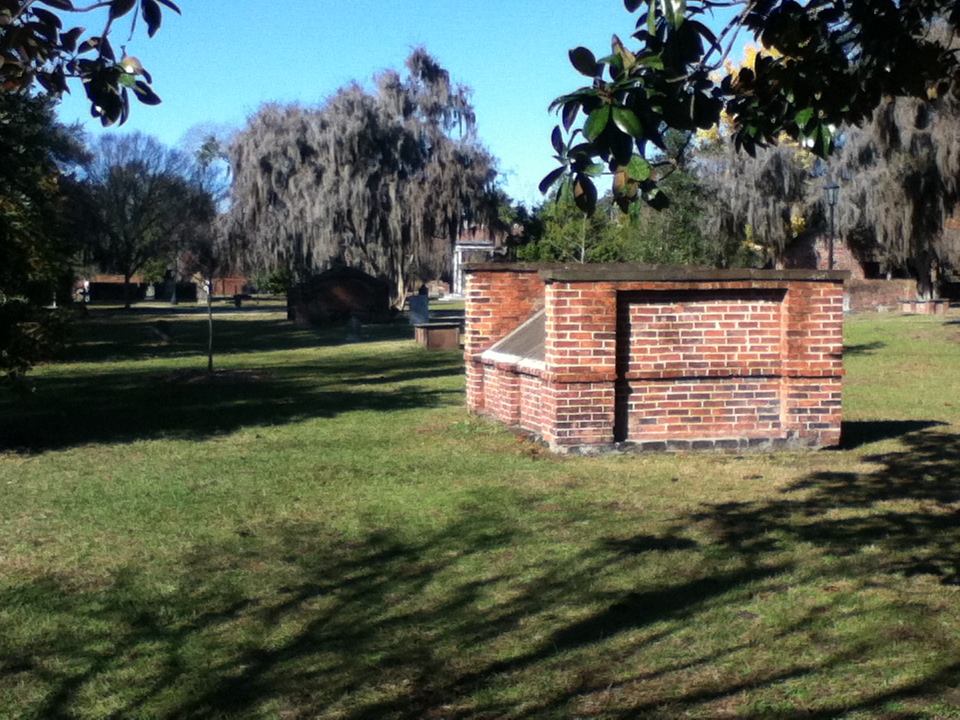
Savannah's Colonial Park Cemetery

My boyfriend, sister and I traveled to Savannah last month, and one place we visited was Colonial Park Cemetery.  Located in Savannah's Historic District, the burial ground dates back to the 1820 Yellow Fever outbreak in the South....


 From the Baltimore Patriot on September 27, 1820:

Charleston, Sept. 19.
Yellow Fever! -- We sincerely regret to inform the Public that several cases of this dreadful disorder have appeared in our City.  Three interments have already been made, the subjects of which died of it, and there are two more persons now ill of the same disorder.-- These persons are all strangers to the climate.--Times.

Accounts from Savannah, represent that place to be in a dreadful situation, from the prevalence of Yellow Fever--200 persons left the City on the 15th inst.--from 12 to 15 die daily--19 persons were buried on the 14th inst. and it was supposed there were then from 2 to 300 lying sick.  It is said "from Tuesday afternoon, at 9 o'clock, till Wednesday morning, 8 o'clock (a space of 29 hours) 49 persons were taken sick, and (on Friday) many of them were silently reposing in the grave"--City Gaz.

Yellow Fever in Newbern--A gentleman from Newbern yesterday, (says the Washington, N.C. paper of the 8th inst.) brings the melancholy intelligence of this dreadful malady having been introduced into that place by a vessel from the West Indies.--Ib.

BOARD OF HEALTH.
Charleston, Sept. 19th, 1820.
The Board of Health sincerely regret that they are compelled to announce to their fellow citizens, that YELLOW FEVER does exist within the city.-- Three deaths have occurred within the last few days, and there are three new cases reported.  The persons who have died were strangers to the climate as are those who are sick of the disease.  By order of the Board,
DANIEL STEVENS, Chairman.


Most of the graves are no longer marked because the headstones have broken.  The broken markers have been placed upon a nearby wall...


Very cool cemetery, I highly recommend it if you like this sort of thing.  I hope one day we'll get to tour Bonaventure, but we didn't have the money to spend on that this time...

September 15, 2011

Leased Cemetery Plots in Cuban Cemetery

From The San Francisco Call of San Francisco, California on April 24, 1904: 
San Franciso Call, April 24, 1904
Havana's Golgotha 
When Americans visit Havana they are confronted with many peculiar customs.  One of the most startling and revolting is that which prevails in regard to the dead.  Colon Cemetery, a beautiful burial ground, laid out in romantic walks, arched with superb trees and adorned with costly monuments and classic cenotaphs, is the last home for all, grandee and peasant alike. 
The rainbow effects of the city's architecture are carried out here, as revealed in the various colors of the crosses which mark the graves; but suddenly, and without warning, the vision is astonished with a grotesque contrast, which is truly a shocking commentary upon civilization. 
It appears that the ground in this cemetery is leased, not sold, and if after a term of five years the renewal rent is not paid the dead forfeit their resting places.  The bodies are ruthlessly dug up and cast into a common heap, exposed to public view along with thousands of other skulls and bones of men, women, and children who can never be traced by posterity.

June 21, 2011

Infant Coffin Carried by Little Girls, Rockcastle, 1898

Previously:

Click here for a list of my other Pulaski/Rockcastle/Laurel County KY articles

-----------

[July 8, 1898] -

Mt. Vernon Signal, Mt. Vernon, Kentucky
July 8, 1898

The infant of Mr. and Mrs. R. H. Levisay died last Friday and was buried in the Presbyterian cemetery Saturday.  The coffin was carried to grave by little girls.

----

We wish to return our many thanks to our friends for their kindness shown us in the sickness and death of our baby.  And especially to the little girls who bore its remains to its last resting place, also to Rev. Carmical for the beautiful little talk which he delivered at the church in his pleasant way.

R. H. Livesay,
Cassie Livesay.


June 15, 2011

Female Professional Embalmer, 1900

This article about a female embalmer comes from the Kentucky Irish American newspaper of Louisville, Kentucky, printed on December, 1, 1900.

EMBALMING.
-------
Interesting Interview With Miss Katie Smith Upon That Subject.
-------
The Only Lady Following That Profession in the South.
-------
Bodies Can Now Be Prepared For an Indefinite Time.
-------
METHOD PRACTICED BY EGYPTIANS
------- 
Miss Katie Smith, daughter of the late Gran W. Smith, the only lady embalmer in the South, has made a long and successful study of the subject of embalming, and today she is recognized as one of the most proficient practicing that art.  There has been a growing demand for her services recently, her reputation extending through many adjoining States, especially as many parents prefer her to men when young women are to be embalmed. 
Miss Smith, whose picture accompanies this article, talked most interestingly and instructively to the Kentucky Irish American upon this subject, giving much information that is known to but a few.  She is now associated with Gran Smith's Sons, the well-known undertakers at Seventh and Walnut streets, a firm that has been in continuous existence perhaps longer than any in this city.  Among many other things she said: 
In order to practice their profession intelligently and successfully there is a certain amount of knowledge that the embalmers should and must possess.  They need not be educated in the classics and arts, but they should be possessed of a certain amount of knowledge of the anatomy and physiology of the human body, particularly those parts pertaining to embalming.  They should have a good general knowledge of the vasular system, a knowledge of visceral anatomy and be acquainted with the formation of the general and serous cavities; be able to raise and inject arteries with ease and with very little mutilation; understand the modern methods of doing cavity work; be somewhat acquainted with the morbid condition of bodies dying of certain diseases, and understand all the expedients that are resorted to by the up-to-date embalmers in overcoming the various obstacles to be met with in the practice of their profession. 

May 30, 2011

Cremation in the United States, 1891-1901

Cremation Increasingly Popular
April 4, 1901, The Conservative, Nebraska City, Nebraska 
It is cheering to note the steadily growing popularity of cremation in the United States. While at the Fresh Pond crematory of New York city there were incinerated in 1900 about six hundred bodies. A newly organized cremation company anticipates that by introduction of improved methods it will be able to increase the number more than a hundred per cent. With the furnaces at present in use by the Fresh Pond crematory, to consume a body requires from two to four hours.  The directors of the new company guarantee to do the work in half an hour. Truth to tell, it has hitherto required three days to transact all the business involved in a cremation. Upon application to the incineration authorities, arrangements were perfected for conversion of the body into ashes on the following day. The next step was to convey the body to the crematory and deposit it in the retort. "On the third day one could call for the ashes. " In the language of a director, you can, under the new regime "call him up over the 'phone in the morning, bring the body over immediately and in an hour go home with the ashes." 
Cremation societies have been greatly handicapped by popular prejudice, but that has now been largely overcome.  They affect to have discovered that their two worst enemies are women and the church. We quote from the New York Sun : 
"Louis Lange, president of one of these societies, says that men often come to him and tell him how they pine to be cremated after death, how they have labored with their loving wives to bring them around to the same view and of how dubious they feel about the future. The burning question with these men seems to be, how to get the wife to agree to the burning. They say she'll be sure to bury them if they happen to die first. The conviction a man may have, that he won't lie easy in his grave under those circumstances doesn't help him much.  But apparently, in some cases his uneasiness reaches the widow. For Mr. Lange says that women often come to him and say: 
"'I can find no rest! My husband wanted to be cremated, but I, basely persuaded, put him in a grave! Now I want him disinterred and cremated.' Hard is the way of the transgressor!" comments Mr. Lange. 

May 24, 2011

Burial of Leon Czolgosz, Quicklime and Sulphuric Acid

After Czolgosz's execution, government officials wanted to destroy his corpse in order to negate relic hunters. Those tasked with destroying Czolgosz's body first used quicklime to hasten deterioration, but later decided to pour sulphuric acid into his grave to completely destroy the corpse. However, there was a small controversy over the effectiveness of this method, as illustrated from the following clipping from the Richmond Dispatch of Richmond, VA, printed November 2, 1901.


Warden Mead Made A Mistake
Czolgosz's Body May Be In Plaster Cast

New York Herald. It is possible that if the body of Leon Czolgosz were exhumed today it would be found well preserved in a plaster of paris cast instead of having been dissolved and disintegrated by the action of the quicklime and vitriol with which it was covered when interred in the prison burial lot at Auburn on Tuesday afternoon.  It had been determined by Warden Mead and Superintendent Cornelius V. Collins to bury the body in a bed of quicklime, so that no trace of the assassin should remain as a possible incentive to relic hunters.

To make certain Warden Mead a few days before Czolgosz was executed placed a piece of raw beef in a jar containing an equal amount of quicklime, but when the Warden opened the jar he was surprised to find the meat practically in the same condition.

Warden Mead and Superintendent Collins then decided to add to the mass of quicklime over Czolgosz body a quantity of vitriol.

This was done. When the body was interred on Tuesday afternoon a layer of quicklime had already been placed in the grave. On this the coffin, the lid of which had been removed, was laid, and the body was then covered with two barrels of quicklime.

Over this a carboy of vitriol, or sulphuric acid was poured, two more barrels of quicklime was thrown in, and over all the earth was shovelled until the grave was filled.

It was anticipated that as a result of the action of the sulphuric acid and the quicklime the body would be dissolved within twelve hours, but it is improbable that this has been the case.

When quicklime and sulphuric acid are combined, the chemical result is plaster of paris and water.  This is the chemical formula:

Ca O plus H2 SO4 equals Ca SO4 plus H2O.  Ca O is the quicklime, H2 SO4 the sulphuric acid, Ca SO4 the plaster of paris resulting from the chemical combination, and H2O the water left over, which, in the course of time, would evaporate.

"It is entirely possible that Czolgosz's body is enclosed in a plaster of paris cast, said Professor Charles F. Chandler, of the College of Physicians and Surgeons and of the University of New York, last night.

"Plaster of Paris would result from the combination of the sulphuric acid and quicklime, but to have the effect of each of them as a solvent entirely neutralized it would be necessary that they should have been combined in exactly the right proportions.

"There is undoubtedly a large amount of plaster of paris surrounding Czolgosz's body if he was buried in the manner described by the newspapers, but there was undoubtedly either too much sulphuric acid or too much quicklime, probably the latter, to make a perfect chemical combination of the entire mass.  There would be enough of either the quicklime or sulphuric acid left over to dissolve the body in the course of time.

"In order to make a plaster of paris cast it would be necessary that there should be ninety-eight parts of the acid to fifty-six parts of the lime--that is, if the acid were absolutely pure.  The vitriol of commerce, however, contains about six and one-half parts of water to ninety-three and one-half parts of pure acid.

"A carboy, as I remember, contains about 150 pounds, which would not be sufficient to entirely neutralize the quantity of quicklime with which the body was covered.  Quicklime would not, under any circumstances dissolve the body in twenty-four hours, but there is undoubtedly enough of it left to do the desired work int he course of time."

This letter, bearing on the matter, was received by the Herald yesterday:

To the Editor of the Herald:
I have just been reading about the cremation of the assassin Czolgosz, and the way Warden Mead expects to destroy the body.  If your account is correct Warden Mead evidently did not know that his modus operandi will cause the body to be kept forever preserved in a matrix of sulphate of lime or plaster of paris, and that he might as well have placed the body in alcohol.

Of course, the action of the oil of vitriol on the lime will produce intense heat, but probably the body will be preserved by that very fact, as the vapor produced around the body will act as a protective layer, or cushion, between it and the surrounding quick-setting plaster of paris.

All this is very elementary, and a tyro* in chemistry could have pointed that out to Warden Mead.  His purpose would have surely been attained with the oil of vitriol alone, or, better, with a strong soda lye (a solution of caustic soda or potash), the latter having been used by a certain criminal in Chicago to effectively destroy the body of his wife.

Newark, N.J., October 30, 1901
CHEMIST


* A tyro is a beginner/novice