Showing posts with label georgia. Show all posts

December 24, 2013

Several Killed in Christmas Day Miners' Riot at McFerran Hotel, Whitley, 1908

Previously:

-----------

[December 26, 1908] -

United States Marshal and Miner Killed; Hotel Burned In Fight in Whitley County

Pitched Battle Between Union Workers and Federal Officials Seeking Arrest of Miners Accused of Violating Injunction Fatal--Others Believed to Have Perished.

(Special to The Herald.)
DANVILLE, Ky. Dec. 25.-- Deputy United States Marshal John Mullins, of Richmond, Ky., and Richard Ross, a miner living at Stearns, were instantly killed in a battle between United States Marshals and miners at Stearns, in Whitley county, sixty-six miles south of Danville this morning.

The McFerran Hotel, in which the miners were barricaded, was burned, presumably to smoke the miners out.  It is thought that four or five of the miners were burned alive in the hotel. In the battle several miners were wounded. 

United States Marshals Tate and Ryan, of Somerset, were wounded, but it is thought that their wounds are not of a serious character.  

How the Trouble Arose.

The trouble came about as the result of an attempt on the part of the union miners to organize the non-union miners at Stearns, numbering over 300.

The Stearns Coal Company, through its attorneys, E. L. Stephens and J. N. Sharpe, of Williamsburg, instituted suit in the United States District Court at Covington recently against J. O. Tunstall and thirty-one others, in which the company sought to enjoin the union men from interfering with the operations of the plaintiff's mines in Whitley county.  Tunstall is the District Organizer of the United Mine Workers of America.  It was charged that the defendants were attempting to bring on a strike.  Numerous threats are said to have been made.

Temporary Injunction Granted.

Judge A. M. J. Cochran caused a temporary restraining order to be issued. Whitley is said to have the largest output of coal of any county in the State.  It is alleged that the strike promoters refused to obey the restraining order granted by Judge Cochran and proceeded with their efforts to organize the miners.  A part of deputy United States marshals went to Stearns yesterday and arrested five miners and landed them in the jail at Somerset.

However, a large number escaped arrest and this morning United States Marshals Siler Ryan, Henry Waddell, Marshal Tate and Marshal Massingale, of Somerset, and Marshal John Mullins, of Richmond, went to Stearns for the purpose of arresting Simpson, a leader in the strike movement, who also connects the McFerran Hotel, the largest hostelry in Stearns.

The marshals found all of the striking miners barricaded in the hotel. No sooner did the presence of the marshals become known than a volley of shots poured out of the hotel at them.  The marshals returned the fire.

Marhsal Mullins, of Richmond, was killed instantly, as was also a miner by the name of John Ross.  The marshals then retreated, but came back, two going to the rear of the hotel and two approaching it in front.

Another pitched battle took place, in which Marshals Tate and Ryan, of Somerset, were wounded.  It is thought that seven of the miners were wounded in the latter conflict.  After the second fight the hotel was fired, women and children fled for their lives, in the midst of the most intense excitement.

Miners Flee From Building.

The miners were slow to come out, but when the roof began falling in they rushed out and fled.  The miners who killed Mullins came out on the veranda and fired directly at his man.  He was fired upon and it is thought that he was wounded and was burning in the building.

Two or three others, who it is thought were wounded, are also said to have been burned in the building.  Marshal Ryan, of Somerset, who was wounded, got separated from the other marshals when the building was burning and is hiding out in the mountains.  A searching party went after him tonight.

Fears for Marshal's Safety.

Great apprehension is felt for his safety, as it is believed that if the irate strike promoters discovered him that he will be murdered.  His family at Somerset is much alarmed.

The body of Marshal Mullins was placeed on a train this afternoon and taken to Richmond.  All the marshals, save Ryan, returned to Somerset at 4 o'clock this afternoon.  A posse of from fifty to one hundred armed men, headed by United States Marshals Massingale and Waddell left Somerset tonight for Stearns.

They will reach that point about 3 o'clock and an effort will be made to capture the strike promoters before the break of day and before they again barricade themselves.

Excitement is intense in all the surrounding country, but it is believed that the posse which will go tonight will be able to capture the leaders.  However, they will go prepared for another battle, if necessary, to capture their men. [1]

August 3, 2013

Description of a North Georgia Gold Mining Operations, 1832

From page 2 of the Savannah Georgian on October 4, 1832:

---

[FROM A CORRESPONDENT.]


GOLD MINES.-- The gold mines that I visited, are situated about 24 miles above Clarksville, and among them is Loud's celebrated mine.  I was cautioned against catching the gold seeking fever so prevalent, but it was unnecessary, as I have always viewed it as the most uncertain speculation that could be pursued, and I saw nothing to alter that opinion.  The first was a mine belonging to a company, one of whom was Mr. Mirable, our host, who superintended it.  Twelve negroes were at work, some of whom were loosing the earth with mattocks, some carrying it to the rocker in barrows, and the others were working that machine.-- It is long and narrow, suspended at the ends to a frame, and rocked by means of a wooden arm that crosses it.  It is covered with an iron plate, pierced like a sieve, on which the earth is laid while a stream of water falling at the head or highest part, washes away all the soil and gravel of a certain size falls through the holes, the larger pieces being worked off.  Below the iron plate is a drawer or trough, divided into compartments, into each of which is a small portion of quicksilver, which active agent fastens upon every particle of gold, however minute, the moment it enters these cells.  We searched the drawer, it then being 12 o'clock, but found only two very small pieces.  The product by these twelve hands since they commenced work they told us had averaged a penny weight (80 or 90 cents) per day each, and this was considered a good business.  Each day's gold is put up in a separate wrapper, and at the end of the month the quick silver is evaporated.  The places most productive were at the base of hills and between them.  The surface soil to the depth of from six inches to six feet is first removed when they come to a strata of gravel which contains the gold.  The work appears to be excessively laborious, attended with great exposure but they say the negroes are healthy and contented; and we did see white people at the same employment, some engaged for their own benefit on small squares of soil they had leased, and others merely as laborers.  Loud's mines, of which I had heard so much, respecting its productiveness, adjoins this.  The proprietor was absent, and I did not perceive more than three rockers at work.  It is said that he bought it of Mr. Blake's agent for $10,000, but the principal in consequence of the sale being without his authority, required $11,000 more.  Vast quantities of gold, it is said, have been extracted here and sent to the native country (England) of the owner, and a solid lump had been dug out, weighing over 800 penny weights, and several very large though smaller pieces.  I could not here, notwithstanding these windfalls, that the products had paid the investment, and I am now told that Loud has sold this property to Col. Dickson, the agent of an English company, for $120,000, and that he (Col. D.) had made further purchases amounting in all to over $300,000.

On this place a complicated inclosure, intended to supersede the rockers in working for gold, worked by a steam engine, the invention of a mechanist named Bosworth, who formerly lived in Savannah, has been erected.  It was prepared at the north, and brought up a great expense, which was enhanced by the difficulty of getting a head of water to supply the boiler and washer.  Unfortunately when put in operation it was an entire failure. Two trials have been made without success, though the projector expects to succeed after a third.  It is a pity that so much expense (from 5 to $10,000) and labor should prove useless.  He has a vein mine, 5 miles from this, where the gold is gathered from the rock pulverised and washed, and I should suppose the engine at any rate would be unfit there.  The deposit mines are on land of the best soil, and it is really melancholy to see God's earth so defaced as these mining operations leave it.  Broad trenches, from 16 to 20 feet long and of a depth sufficient to get out of the whole strata of gravel, are dug, the substance all carried off by water, whilst the stones in huge heaps washed and bleached lie at their sides, thus totally ruining it for agricultural purposes.  Whole acres of what was productive soil are to be seen in this way pricked to the bones in appearance and destroyed.  Before the gold-finding machines, or rockets, came in use, the gold was obtained by pouring, a tedious process.  A man takes an ordinary tin pudding pan, fills it with earth, and with both hands holds it in the water, where he puts it in motion so as to wash away the soil, throwing out the gravel until there remains but a small portion in the bottom, when he washes more carefully until all the earth and gravel is exhausted and the gold, if any, remains.  The panning I saw produced by a few minute particles hardly discernible and not worth collecting.  I saw parties of two and three persons arrived with spades and pans, travelling about among the mines, picking up what they could catch.  Indeed the neighborhood was crowded with persons connected with the mines looking for land, buying gold, selling bacon, and corn, &c, &c.  A few, as I could learn, very few, make money out of gold hunting.  Your money makers and the speculators in gold lots, buying the land from the original owners and selling at ten and twenty times the cost.  The total number of persons whose manual labor is employed in the search in the counties of Habersham, Hall and Rabun, is about 2500, but I do not believe that if the total product was divided among them they would be paid.  The whole amount of gold found in our state cannot be ascertained, because so much of it is remitted in bars to Europe.  Agents are constantly going about buying it up and some of the banks have resident agents for that purpose and to circulate their bills.  Wonderful tales are in circulation respecting the richness of the lands in Cherokee county, arising no doubt from the strict guard kept over it.  I heard it seriously said that a man could make $20 a week by crossing the river, filling his saddle-bags with earth and returning to this side to pan it.  A company have got a large flat in the Chestata[?], with iron buckets to scoop up the sand from the bottom, worked by horses, on the same principle as our dredging machine for deepening the river.  The sand is discharged on board and washed in the usual manner.  The boat is allowed to work only on the one side or half of the river, and I could learn nothing positive as to the successes of the scheme.  It is difficult to ascertain what are the actual profits of these adventurers.  I could not learn that any of them were getting rich, and I sincerely believe that if the only gold obtained was that in small particles through the rockers, many would soon abandon the pursuit; but it is the larger lumps of the glittering metal that are sometimes found that will make men mad and keep up the excitement.

It was told as a fact that about the time gold was first discovered, a person named Hernden of Elbert county, visited a tract he had drawn in Habersham, where finding it apparently of no value, gave it to his entertainer, Powel, for his night's lodging, and gave a written promise to execute titles.-- Shortly after gold was discovered on it, and Powel got $4000 for it.  The original owner threw no difficulty in the way when informed of its value but promptly and honestly made titles.  It now belongs to D. Blake, who gave $5,300 for it.  Many impositions have been successfully practised in the sale of lots by what is termed salting, that is a few penny weights of gold are judiciously sprinkled over those parts exhibiting the other decisive signs of its existence, so that as the proof is in, the "panning," the gold gold hunter must inevitably find some "particles" and bids accordingly.  A gentleman at whose house we staid one night was duped in this way, but now laughs at the deception as it only cost him a few hundred dollars.  He placed twelve hands at work, who after thirty days of incessant labor exhibited about $13 worth of gold as the result!  There being no possibility of proving deception there is no redress.

October 20, 2012

Moore's Heirs vs. Shepherd et al., Taylor/Wayne, 1865

Previously:


-----------


Moore's heirs vs. Shepherd, &c.

COURT OF APPEALS OF KENTUCKY

63 Ky. 125; 1865 Ky. LEXIS 27; 2 Duv. 125

September 25, 1865, Decided

PRIOR HISTORY:  [**1]  APPEAL FROM TAYLOR CIRCUIT COURT. 

DISPOSITION: Reversed and remanded.

COUNSEL: HOOE & GAITHER, HUNT & BECK, and A. J. JAMES, for appellants.

BRAMLETTE & VANWINKLE, HARLAN & HARLAN, for appellees. 

JUDGES: JUDGE ROBERTSON. 

OPINION BY: ROBERTSON 

OPINION
 [*125]  JUDGE ROBERTSON DELIVERED THE OPINION OF THE COURT:

A very voluminous record of multitudinous facts, apparently conflicting, makes this case vexatiously difficult, and stamps on its face an extraordinary impress peculiarly dramatic, and, therefore, signally interesting.

The great issue is personal identity, involving the question--which of two men, perhaps three, and possibly four, named William Perry Moore, was the son of John S. Moore, deceased, of Monticello, Wayne county, Kentucky, to whom, as heir of the decedent, was allotted an estate for which the appellants, as the infant daughters of one of the William Perry Moores, brought this suit in equity in the year 1854, about one year after their father's death, in Baltimore, whither he had removed about the year 1845, from Columbus, Georgia.

William Perry Moore, the son of John S. Moore, was born in Monticello, and there resided until June, 1835, when, in his  [*126]  eighteenth [**2]  year, indignant at an ignominious chastisement by his mother, who, after his father's death, had married Isaac Shepherd, he secretly left Kentucky, declaring that she should never again see or hear of him. He left in the night on a horse, taken without leave, from his step-father, but soon restored to his possession by a mail-carrier, to whom it was delivered for that purpose, and the fugitive never returned to Kentucky, or was heard of by his mother until the year 1841, when she heard that a man of his name, likeness, and age, was residing in Columbus, Georgia. That man entered Columbus about the first of the year 1838, married there in 1840, acted there as town constable, and there the appellants were born, and to two of whom he gave the names of two of the John S. Moore's daughters whom he claimed as his sisters.

In 1841-2, some acquaintances of the fugitive's mother, driving stock to the Columbus market, were requested by her to see the W. P. Moore residing at that place, and ascertain whether he was her son. They accordingly saw him and interrogated him, and reported, and afterwards testified, that, though he resembled her son, seemed to know her daughters and their names,  [**3]  and the names of their husbands, and also the names of other persons in and near Monticello, and said that he was born there, yet, as he did not seem to remember some other persons with whom her son had been intimate, and, moreover, appeared evasive and inconsistent in his conversation, they were inclined to the opinion that he was not her son. This report, and the fact that a letter she had addressed to him was answered in the handwriting of his wife, induced her to renounce and denounce him as an impostor; and when, after his death, his wife and children came to Monticello to repel all imputation of imposture, and claim the estate in the hands of the wanderer's mother as his guardian, she refused to recognize them or their claim, and this suit soon followed that non-recognition and refusal.

The issue of personal identity was, on the motion of the appellants, with the apparent concurrence of all parties, submitted to a jury, who found that the father of the appellants  [*127]  was the son of John S. Moore, of Monticello. That verdict was set aside on affidavits for a new trial, for new testimony.

A similar verdict by another jury stood the test of another motion for a new trial, [**4]  which was overruled, and thereupon the case was continued. Afterwards, without noticing the judgment overruling the motion for a new trial, a new judge permitted other trials, in which there was no verdict; and, finally, another judge, dispensing with a jury, dismissed the petition, from which judgment this appeal is taken.

A question of fact and a question of law are presented for our consideration. 1st. What is the most rational deduction from the testimony? 2d. What is the legal effect of the second verdict and of the judgment overruling a motion for a new trial?

1. The concurrent testimony of his family relations, and other intimate acquaintances, describes the person of William Perry Moore, the son of John S. Moore, of Monticello, when he left that place, as peculiarly characteristic and substantially as follows: About eighteen years of age; about five feet nine and a half inches high; weight from 160 to 170 lbs.; shoulders broad and rather stooped; breast correspondently thin and hollow, indicative of hereditary consumption. Hair light brown; eyes bluish grey; skin fair, with sallow tinge; hands and feet large; port careless, awkward, and abrupt; a small scar, nearly round,  [**5]  on the edge of the left jaw; an eliptical scar ranging from the inner corner of the left eye, through the brow, to the left temple; a dimple in the chin, and another on the left cheek. And, with full and exact precision, the same description is given of the father of the appellants by a multitude of his acquaintances in Columbus, Georgia.

Two of the Monticello witnesses testified, also, that the Wm. Perry Moore, who was the son of John S. Moore, had, by fracture or otherwise, lost a corner of one of his front teeth; and exhumation of the father of the appellants disclosed the same dental defect, and also the impress on the skull of the scar through the left eyebrow. Had those two witnesses testified falsely, it is almost certain that their error would have been proved by the other Monticello witnesses who testified against  [*128]  the appellants. The fact thus testified to must be, therefore, accepted as established.

And the testimony of several of his acquaintances in Baltimore described him exactly as the Georgia witnesses did, and proved that he died of pulmonary consumption, and had claimed Kentucky as his birthplace and title to property here.

All these [**6]  minute and extraordinary coincidences would, if unrebutted by any other fact or circumstance, indisputably prove that the father of the appellants was the son of John S. Moore, of Monticello.

But, remarkable as it may be, there are some countervailing facts, both striking and perplexing.

1st. As before suggested, the father of the appellants sometimes seemed not to know persons in Monticello, and Wayne county, whom he should be presumed to remember, if he had been born and had lived there until he was eighteen years old. The only clue to this apparent inconsistency is his avowed determination to conceal himself from his mother as long as she might live. But the inquiry at once arises why did he, at the same time, and often, say that he was John S. Moore's son, and was, as one of his heirs, entitled to a fourth of his estate? The only answer is, that he was anxious, not to renounce or bar his claim, but to keep it alive, and, at the same time, to conduct himself in such a way as to make his repudiated mother doubt and even deny his identity. And it seems to us that this is a plausible and probably true explanation of his apparent contradictions and inconsistencies. And this construction [**7]  is fortified by the significant fact, that, claiming John S. Moore's three daughters as his sisters, he gave to two of his own daughters the very peculiar names of two of those recognized sisters. Sarah Adelaide and Mary Evaline are the names of the two oldest of the appellants, and two of John S. Moore's daughters bear the same names.

This cogent coincidence, and the avowed and natural reason for it, are not neutralized by the assumption that, before those coincident nominations, the father had obtained in Columbus minute information about the family of John S. Moore, and its status and names. If he were an impostor, such a presumption  [*129]  would be intrinsically improbable, until after he had named his first child; for, until after that time, he had not, so far as the testimony goes, been interrogated by, or had any communication with, any person from Wayne county or its neighborhood, concerning his own history or that of John S. Moore. Nor does it appear, that, while he lived in Columbus, the names of John S. Moore's daughters had been communicated to him by any person in Kentucky, Georgia, or elsewhere.
2d. The proof shows that a boy named William Perry Moore [**8]  , born and raised in Wheeling, Virginia, and resembling in many peculiarities the William Perry Moore of Monticello, left Wheeling in the year 1836, as an employee on a steamboat destined for the Chattahoochie and Columbus, Georgia, and had never afterwards returned or been heard of, except perhaps once. He might have reached his destination some time in the year 1836. The father of the appellants was also employed on a steamboat in the Chattahoochie trade; but he did not appear there sooner than the first of the year 1838.

Moreover, the Wheeling Moore was two or three years younger than he, was not quite so robust, and is not shown to have had any of his dimples or scars on the face. We could not, therefore, safely presume that the Wheeling Moore was the father of the appellants.

3d. But the appellants are beset with another vexatious circumstance much more formidable and extraordinary. A man named William Perry Moore was in the Texan army of independence, in the years 1836-7. In age, size, complexion, and other respects, he resembled the son of John S. Moore, of Monticello, in an impressive manner, even in the dimples and scar towards the left temple. The only difference [**9]  between the scar of the soldier and that of John S. Moore's son, as described by the testimony, is, that the latter was from the inner corner of the left eye, through the eyebrow, to the temple, and the former was from the outer corner of the left eye to the temple. But this apparent diversity may not prove any essential variance in fact, because the only witness who  [*130]  described the soldier's scar did not seem or profess to have any precise recollection of the location of the scar, nor even of the side of the face on which it was, and, therefore, he might easily be mistaken in a slight deviation from a portion of its entire range; and that he was so mistaken is rendered quite probable by the inexplicable fact that this solder said that he was born in Monticello, Kentucky, and owned real estate and negroes there; that he intended, as soon as he could, to return there to see his family and enjoy his property; that he left there in consequence of maltreatment by "some of the family," and that he rode, for some miles, a horse taken from "a member of the family" and returned it by the mail-boy, and manifested an acquaintance with persons in Wayne and the adjoining  [**10]  county of Pulaski.

Now, unless he was the fugitive son of John S. Moore, it would be difficult to account for his striking resemblance to him, or to imagine how he knew the persons he described, or why or how he fabricated a tale so minutely and circumstantially coincident with the motives and manner of the exodus of John S. Moore's son.

It is difficult, therefore, to escape the conclusion that the Texan soldier was that son, who, having left home in June, 1835, went to Texas, and there joined the army in 1836. And if this be so, a hard and vexatious problem is presented to the appellants for solution; for the testimony tends strongly to show that the soldier, William Perry Moore, was killed in Texas, in July, 1841, when their father, a married man with one child, was living in Columbus.

This problem can be solved favorably to their claim in one only of two ways: 1st. By supposing that the Wheeling Moore was the Texan soldier, who left home in the year 1836; or 2d. By presuming either that the soldier was neither the Wheeling nor Monticello Moore, or that the Moore who was killed in 1841 was not that same soldier. The first supposition cannot be reasonably indulged,  [**11]  because the Wheeling Moore is not shown to have been identified by the facial peculiarities of the soldier and the Monticello Moore, and because, more especially, we can presume no motive for his repudiation of his birthplace, and the assumption of a false one, nor any  [*131]  clue to the history of the Monticello Moore and tale of the army Moore.

And, if we admit, without deciding, that the Texan soldier of 1836-7 was the Monticello Moore, still we may, consistently with the testimony, presume that the Moore killed in 1841 was not that same soldier Moore. The Moore who was killed was called and known only as "Perry Moore," and not only does no witness describe him so as to approach the identification of him with the soldier "William Perry Moore," but the description of him lacks most of the same personal and peculiar characteristics; and, moreover, William Perry Moore, the Texan soldier of 1836-7, expressed an anxious purpose to return home as soon as he should be discharged, and could obtain the necessary means, which he expected whenever discharged, and, doubtless, did then get in his pay, and which was in 1837, allowing him, if he then started homeward, time to reach [**12]  Mobile in the fall of that year, engage to serve on a Chattahoochie steamboat, and arrive on it the first of the year 1838 at Columbus, all of which the father of the appellants did, according to the proof. And, besides, the Wheeling Moore was commonly called "Perry Moore," and resembled the "Perry Moore" who was killed in 1841 much more than the William Perry Moore of Monticello, or of the army of 1836-7. We are, therefore, inclined to the conclusion that the said soldier was the William Perry Moore of Monticello, and was, also, the father of the appellants. But whether that soldier was the Monticello Moore or not, we incline to the opinion that, all things carefully considered and harmonized, as far as may be logical, the probabilities preponderate in favor of the conclusion that the Monticello Moore was the father of the appellants.

If, however, the probabilities be equiponderant or incline the opposite scale against the appellants, we are, nevertheless, of the opinion that the last verdict should stand, and conclude the issue of identity. According to the common law, a verdict on an issue in chancery, dependent on controverted facts and contradictory or doubtful evidence,  [**13]  was entitled to considerable influence, and certainly to enough to make it  [*132]  decisive whenever it is well sustained, as the verdict in this case is, by the testimony rationally weighed and considered. But our Code of Practice should be construed as intended to modify the common law in this respect, by giving to such a verdict as much effect as a verdict in a common law action would be entitled to on a motion for a new trial, under and according to the provisions of the Code. (See section 343 on Trial, and also the chapter on New Trials, applying to verdicts on all issues equally and without discrimination.) And even if this be not the precise purpose and effect of the Code, we cannot doubt that, when, as in this case, the parties prefer a jury and elect a trial of an issue of fact by the jury rather than the court, the verdict is entitled to as much effect as if either party had demanded a jury as a legal right.

The verdict in this case having been affirmed by the judgment overruling a motion for a new trial, there was, according to the record, no revivor of it in the subsequent proceedings, and, without the consent of the appellants, the court had no right to revoke [**14]  its judgment at a subsequent term. The subsequent orders by the court sua sponte of successive juries and final resumption of the issue by the court, neither set aside the verdict nor estopped the appellants from ultimately relying on it as an authoritative decision of the litigated question of identity.

We are, therefore, of the opinion that the circuit court erred in dismissing the petition.

The plea of the statute of limitations, by the distributees of the property allotted to the father of the appellants, is not sustained. Knowing that it was held in trust by his guardian, they not only took it as such, but expressly agreed to hold it subject to the claim of himself or representatives.

With knowledge of the trust they took the property by implication of law, as much subject to the trust as it was in the hands of the guardian, and she continued to hold her own allotted portion just as she had held the whole before that distribution. The limitation of an implied trust in movable property is only five years after an open renunciation of the trust by the trustee and an evident use of it wrongfully as his  [*133]  own absolute and exclusive property; but the division itself [**15]  in this case necessarily implied that the recipients made it only because they believed that W. P. Moore was then dead without issue; and, consequently, each distributee took to hold subject to that contingency, and not in his own absolute right, if W. P. Moore was then alive and should ever claim his portion, or leave any descendant who should claim it; and this is intrinsic proof that their possession and use were not adverse to said Moore or his descendants, and should not be presumed to have been so; but this legal presumption is made even stronger and more conclusive by extraneous testimony that, when the distribution was made, the parties expressly agreed to hold their respective portions subject to the contingent right of W. P. Moore or his issue, and, to that extent, they were bailees and must be presumed to have so held. Neither any statutory nor presumptive bar could, on such facts, apply to the remedy sought by the appellants as the children of said W. P. Moore.

The distributees are, therefore, respectively liable to restitution pro tanto with intermediate profits, if any, but not responsible for deterioration without their fault, nor for the value of any [**16]  slave who may have died or become free without their connivance or assistance, but should account for the value of any they may have sold, and the value also of their use. Upon this basis, on the return of the cause, the circuit court will decree to the appellants their father's allotted portion of his father's estate.
Wherefore, the judgment is reversed, and the cause remanded for proceedings and decree conformable with this opinion.

May 24, 2012

"Lincoln's Storytelling Propensity"

This one comes from the Southern Banner of Athens, GA on March 11, 1863:

Russell, of the Times gives the following illustration, which he himself witnessed, of Lincoln's story-telling propensity:

Mr. Bates remonstrating apparently against the appointment of some indifferent lawyer to a place of judicial importance, the President interposed with "Come now Bates, he's not half as bad as you think.  Besides that, I must tell you he did me a good turn long ago.--When I took to the law, I was going to court one morning, with some ten or twelve miles of bad road before me, and had no horse.  The Judge overtook me in his wagon.  "Hello, Lincoln! are you not going to the Court House? Come and I'll give you a seat."  Well, I got in and the Judge went on reading his papers.  Presently the wagon struck a stump on one side of the road; then it hopped off to the other.--I looked out, and I saw the driver was jerking from side to side in his seat, so says I, "Judge, I think your coach man has been taking a little drop too much this morning."  "Well, I declare, Lincoln," said he, "I should not much wonder if you are right, for he has nearly upset me half a dozen times since starting."  So putting his head out the window, he shouted, "Why you infernal scoundrel, you are drunk;"  Upon which, pulling up his horse and turning round with great gravity, the coachman said, "By gorra! that's the first rightful decision you have given for the last twelve-month."

April 19, 2012

Miscellaneous Anecdotes No. 2

From the Daily Public Ledger of Maysville, KY on July 27, 1899:


Used Some Choice Epithets

VANCEBURG, Ky., July 28.--Mrs. Martha Sparks has been sent to jail in default of the payment of a $5 fine assessed by Squire Hays.  She was arrested on complaint of John Morris, who proved that Mrs. Sparks had called him a bald-headed scorpion and a bow-legged rhinoceros.


---

From the Southern Banner of Athens, GA on April 10, 1861:

A fellow out West being asked whether the liquor he was drinking was a good article, replied: "Wal, I don't know, I guess so.  There is only one queer thing about it.  Whenever I wipe my mouth, I burn a hole in my shirt sleeve."


----

From the Marietta Journal of Marietta, GA on June 15, 1877:


A minister was riding through a section of the State of South Carolina, where custom forbade innkeepers to take pay from the clergy who stayed with them.  The minister in question took supper without prayer and ate his breakfast without prayer grace and was about to take departure when mine host presented his bill. "Ah, sir, said he, I am a clergyman."  "That may be," responded Boniface; "but you came here, smoked like a sinner, and ate and drank like a sinner, and you slept like a sinner; and now, sir, you shall pay like a sinner." 


---

From the Daily Evening Traveller, Boston, MA on August 11, 1860:


If wooden heads were as serviceable in war as wooden walls, England would have no occasion to fear France.


.

April 15, 2012

Snakes on a Train

From the Marietta Journal of Marietta, GA on May 1, 1936:


Rattlers Loose On Cincinnati Train


ATLANTA, Ga., May 1.--(UP)-- Several rattlers and other snakes which broke loose from their box had an express car on a passenger train all to themselves today as railway officials sealed the car and warned employees of the cargo. 

An attempt may be made to recapture the snakes at Cincinnati when the Flamingo, fast train from Florida, stops there.

A snake charmer was sought at Macon yesterday to do something but the plan was dropped in order to avoid delaying the train.

The repties were in route from Fort Lauderdale, Fla. to the Detroit Zoo at Royal Oak, Mich.  It was believed only one box of snakes escaped, but these included two rattlers, a coach whip and one other reptile.  Five boxes of snakes are in the car.

Charles Woodall, express messenger, discovered the loosed snakes in the car near Albany, Ga.  He left the car immediately.  When the car reached Atlanta, a few packages were removed by express employees who worked very rapidly.  One snake was seen slithering across a hamper of beans and the car was quickly sealed.


January 10, 2012

Savannah's Colonial Park Cemetery

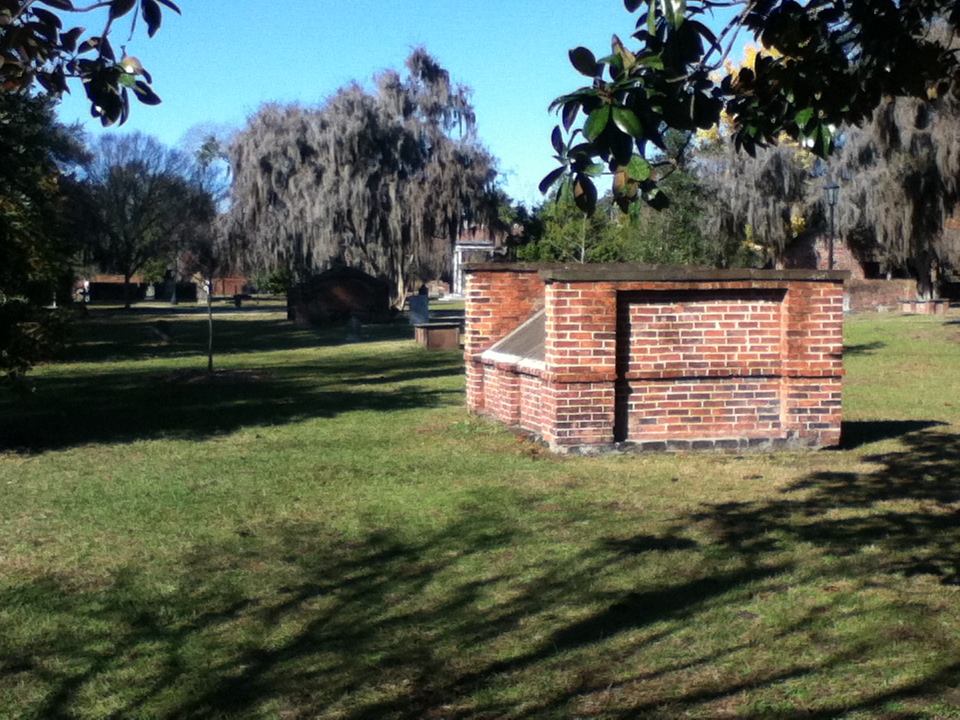
My boyfriend, sister and I traveled to Savannah last month, and one place we visited was Colonial Park Cemetery.  Located in Savannah's Historic District, the burial ground dates back to the 1820 Yellow Fever outbreak in the South....


 From the Baltimore Patriot on September 27, 1820:

Charleston, Sept. 19.
Yellow Fever! -- We sincerely regret to inform the Public that several cases of this dreadful disorder have appeared in our City.  Three interments have already been made, the subjects of which died of it, and there are two more persons now ill of the same disorder.-- These persons are all strangers to the climate.--Times.

Accounts from Savannah, represent that place to be in a dreadful situation, from the prevalence of Yellow Fever--200 persons left the City on the 15th inst.--from 12 to 15 die daily--19 persons were buried on the 14th inst. and it was supposed there were then from 2 to 300 lying sick.  It is said "from Tuesday afternoon, at 9 o'clock, till Wednesday morning, 8 o'clock (a space of 29 hours) 49 persons were taken sick, and (on Friday) many of them were silently reposing in the grave"--City Gaz.

Yellow Fever in Newbern--A gentleman from Newbern yesterday, (says the Washington, N.C. paper of the 8th inst.) brings the melancholy intelligence of this dreadful malady having been introduced into that place by a vessel from the West Indies.--Ib.

BOARD OF HEALTH.
Charleston, Sept. 19th, 1820.
The Board of Health sincerely regret that they are compelled to announce to their fellow citizens, that YELLOW FEVER does exist within the city.-- Three deaths have occurred within the last few days, and there are three new cases reported.  The persons who have died were strangers to the climate as are those who are sick of the disease.  By order of the Board,
DANIEL STEVENS, Chairman.


Most of the graves are no longer marked because the headstones have broken.  The broken markers have been placed upon a nearby wall...


Very cool cemetery, I highly recommend it if you like this sort of thing.  I hope one day we'll get to tour Bonaventure, but we didn't have the money to spend on that this time...

June 7, 2011

June 31st - Gravestone


       CLACKUM
William Clackum  |   Jane Clackum
June 31, 1850      |   Sept 13, 1852
May 28, 1904      |   May 10, 1931
    Gone, but not forgotten

Gravestone located in Citizens Cemetery, Marietta, GA

William's birthdate according to this gravestone is June 31, which is not a real date. I think it should say June 3, 1850. In the book The First Hundred Years: A Short History of Cobb County, in Georgia by Sarah B. G. Temple, published in 1934, there is a transcription of all graves in this cemetery, Citizens Cemetery, Marietta, at that time. She transcribes this grave as: "W. R. Clackum June 3, 1850 May 28, 1904"

Although the book was published in 1934, the author undertook the task of trying to compile and publish a comprehensive transcription of all cemeteries in Cobb County at the time, which likely took several years to accomplish.    Jane Clackum's grave is not listed in the book despite dying in 1931.  It is reasonable to assume she died during the same time period as the author was transcribing these graves and therefore didn't make the book. Perhaps there was a different headstone at that time for William, and it was replaced when Jane died to give them a joint headstone. Reasons I think there was a different headstone is because the birth date differs, and secondly, his name is not transcribed in Temple's book as being written out William as it is in the above pictured headstone. Instead his initials are given, whereas his middle initial does not even appear on the present gravestone.

May 18, 2011

1886 Earthquake felt in Macon, GA

This newspaper clipping comes from the Mount Vernon Signal in Rockcastle Co., KY, although it's about Macon, GA. The date of the paper is October 31, 1902.

Frank Pickle (from Vicar of Dibley) would have totally done this:

Mt Vernon Signal, October 31, 1902
 An old town official of the city of Macon, Ga., says in Short Stories that during the night of the earthquake disturbances of 1886 the City Council was in session.  When the quake shook the City Hall from Basement to attic the Councilmen run out, thinking the house would topple over.  Whereupon the wag who kept the minutes of the meeting, concluded his record with the following sentence:  "On motion of the City Hall, the Council adjourned."

May 16, 2011

Fatal Train Collision in McDonough, GA, 1905

From the Atlanta Journal Constitution on February 3, 1905:

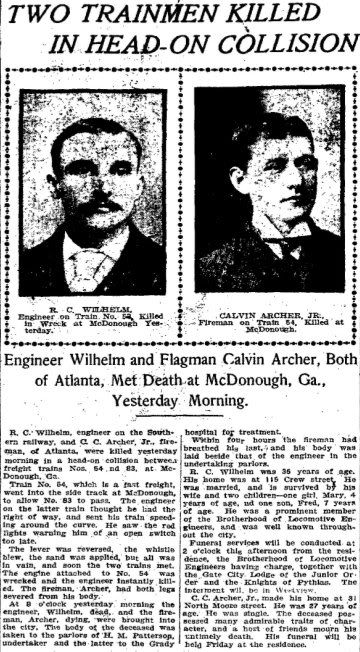
Two Trainmen Killed In Head-On Collision
Engineer Wilhelm and Flagman Calvin Archer, Both of Atlanta, Met Death at McDonough, Ga., Yesterday Morning.
AJC - February 3, 1905
R. C. Wilhelm, engineer on the Southern railway, and C. C. Archer, Jr., fireman of Atlanta, were killed yesterday morning in a head-on collision between freight trains Nos. 54 and 83, at McDonough, Ga.

Train No. 54, which is a fast freight, went into the side track at McDonough, to allow No. 83 to pass. The engineer on the latter train thought he had the right of way, and sent his train speeding around the curve. He saw the red lights warning him of an open switch too late.

The lever was reversed, the whistle blew, the sand was applied, but all was in vain, and soon the two trains met. The engine attached to No. 54 was wrecked and the engineer instantly killed. The fireman, Archer, had both legs severed from his body.

At 8 o'clock yesterday morning the engineer, Wilhelm, dead, and the fireman, Archer, dying, were brought into the city. The body of the deceased was taken to the parlors of H. M. Patterson, undertaker and the latter to the Grady hospital for treatment.

Within four hours the fireman had breathed his last, and his body was laid beside that of the engineer in the undertaking parlors.

R. C. Wilhelm was 36 years of age. His home was at 115 Crew street. He was married, and is survived by his wife and two children--one girl, Mary, 4 years of age, and one son, Fred, 7 years of age. He was a prominent member of the Brotherhood of Locomotive Engineers, and was well known throughout the city.

Funeral services will be conducted at 2 o'clock this afternoon from the residence, the Brotherhood of Locomotive Engineers having charge, together with the Gate City Lodge of the Junior Order and the Knights of Pythias. The internment will be at Westview.

C. C. Archer, Jr., made his home at 31 North Moore street. He was 27 years of age. He was single. The deceased possessed many admirable traits of character, and a host of friends mourn his untimely death. His funeral will be held Friday at the residence.