Showing posts with label obituary. Show all posts

February 15, 2020

W. I. Moore, Jr. Kills his Brother-in-law J. K. McCormack, Lincoln, 1881


[February 18, 1881] -


Murder.

A carnival of murder seems to be in progress in the West end of this county, as reference to our Hustonville letter will show. Three men have been killed in one week within two miles of each other, making six in less than a year in one voting precinct! Such a state of affairs is terrible to contemplate, and a sober thought only is necessary to convince any one that a radical change, both in public sentiment and in the administration of the laws, is absolutely needed and at once.

Let us look at the facts in the murders of one week. J. K. McCormack, a native of the county and a Cincinnati drummer by occupation, visits Hustonville on business. He arrives somewhat under the influence of liquor, and in a short tie has a dispute with one of his brothers-in-law. Later in the evening, W. I. Moore, Jr., arms himself with a pistol as if intent on murder, and passes Mr. McCormack and G. W. Drye, who were talking on the street. McCormack made some remark which Drye did not catch, but which others testify was "I'll cut your heart out;" whereupon Moore, although he could see that McCormack was unarmed, turned and fired at him twice, one ball passing through his heart and killing him instantly. This so far as the examining court could ascertain, was the sole cause that lead one brother-in-law to take the life of another.

The second killing is the cowardly assassination of Cam Rowsie by Bill Gresham and John Read. Rowsie was passing along the road from Moreland Station to his home at Milledgeville, when these two fiends, afraid to give their victim a fighting chance, emerge from a thicket and shoot three loads of buckshot into his body before he is hardly aware of their presence. He dies instantly, and the assassins, confident that they will be acquitted because Rowsie had the reputation of a dangerous man, surrender themselves to an officer.

The third murder is by a negro, who, seeing his white brethren so handy in taking the law into their own hands and receiving no punishment therefor, stabs another negro to death. This is the startling record of one week in one precinct! Can the law-loving man contemplate such carnage without shuddering to see to what we are drifting? True, McCormack had killed two men and was considered desperate when drinking. It is equally true that Rowsie was a desperado and had shot one or more men, but these are no reasons that they should be killed like dogs; and but for the law enforcement, or rather no enforcement of the laws, their murderers would not have dared to spill their blood. The Courts, the juries, and last, but at no means least, the Governor, are to blame. The people too should come in for no small part of the responsibility. A maudlin sentiment in regard to murderers, entertained by a majority of the masses, and the hero worship which some men give to such cattle is primarily the cause that induces many to dabble in gore. The Courts have lost their prestige, and the juries, which are not often made up of the best men, are swayed either by a fellow-feeling or a bribe, and in nine out of ten cases, they turn loose the human hyena without sense or reason to prey again on unsuspecting humanity. And, if in the tenth case, a jury is found that is faithful to their oaths, our dear old Governor stands with pardon in hand, ready to thwart both law and justice. This is a plain and unvarnished statement of our condition, and we grieve to know that it is so fearfully true. A gentleman, who has been keeping the count, says that in the six years and six months that he has lived in this county, there have been fifty-four murders! No one has been hanged, and only one (a poor devil who confessed) sent to the penitentiary for life. We hope that the murders of this week will awake our people to the enormity of the crimes committed right under their noses, and that a revulsion in sentiment will follow. A few legal hangings would put an end to this reign of the assassin and lift the "dark and bloody ground" to the position of a law-abiding State, which her education and advantages entitle her. [1]


June 26, 2014

Salesman Killed in Freak Accident at Saw Mill, 1909

Previously:

-----------

[March 19, 1909] -

HORRIBLE DEATH:--

Manly C. Albright, of Brodhead, traveling salesman for Stratton & Terstegge, met with a most horrible and tragic death Tuesday.  He had gone to W. M. Bullock's place of business about four miles south of here to sell that gentleman a bill of hardware.  Mr. Bullock was at his saw mill and the deceased stopped at the mill to see him.  It was about dinner time and Mr. Bullock asked Manly to go over and take dinner with him.  Passing out of the mill shed, they had to pass over the saw shaft, which was running at full speed.  Mr. Bullock passed over in safety, but the long overcoat worn by young Albright, caught on a set screw as he was passing over and in the twinkle of an eye his body wrapped about the whizzing saw rig and his life instantly beaten out, against the heavy timbers as he was whirled through the air.  Messrs John Marler, W. M. Bullock and James Johnson witnessed the awful occurrence and as best they were able to tell, the shaft made between five hundred and a thousand revolutions, before they were able to stop the engine.  The body was badly cut and bruised and there was hardly an unbroken bone in the body.  Undertaker Granville Owens, came up from Brodhead and he with Mr. A. B. Furnish and others went to the eventful spot picked up the body, which had already been cared for as best it could, by Mr. and Mrs. Marler, and others, and brought it to Mt. Vernon when it was shipped to his home at Brodhead.  Mr. J. C. McClary, the Stanford undertaker met the body there and prepared it for burial, which took place yesterday, near McKinney, Lincoln county.

But few young men could claim a wider circle of admiring friends than he.  His polite and genial manners, honesty, integrity and faithfulness to every trust won him the esteem, confidence and admiration wherever he was known.

No bronze or marble shaft, no splendor of ancient or modern tombs and no play of immortal genius can adorn the memory of such manly men.  Their lives, their deeds, their influence, living or dead, and their pure aspirations are the monuments that will keep their names burning in the home and the hearts of kindred and brethren, while the flying moments are dimming with their dust and rust the inscription upon the brightest obelisk in the cemetery.

While the silence of death wraps and chills us at this moment, memories, sweet and precious, come crowding in.

The remains were laid to rest yesterday the I.O.O.F's of which order he was an honored member, officiating. [1] 

------------------------

[1] "Horrible Death." Mount Vernon Signal, Mt. Vernon, KY. March 19, 1909. Page 3. LOC. http://chroniclingamerica.loc.gov/lccn/sn86069561/1909-03-19/ed-1/seq-3/

.

August 6, 2013

Tragic End to a Love Story that Never Was, 1890

I saved this article for the editor's euphemisms to hanging and the description of how the deceased was buried.

From page 5 of the Chicago Herald of Chicago, IL on October 4, 1890:

---

WILD LOVE OF A COWBOY.

Failing to Secure the Girl of His Heart He Ornaments a Wyoming Tree.

Cheyenne, Wyo., Oct 3.--A Week ago to-day the body of a cowboy, James McKee, was found hanging to a tree near a ranch on the Laramie River.  The coroner was wired that it was a clear case of suicide and concluded an inquest was unnecessary.  The story was brought in this evening, and it is found the supposed self-destruction of a daft range hand develops into a romantic tale.  McKee was attached to an outfit on the Nebraska border.  He fell violently in love with a girl of thirteen, travelling overland to Oregon with her sister and brother-in-law.  The child did not care for him, but he pressed his suit and followed the movers.  Time, after time was he rejected by the thoughtless miss, but he was only the more enamored of her pretty face.  Thursday afternoon the girl's male protector told McKee the thing had gone far enough and ordered him to break away.  The rancher departed in sore distress.  Next morning the blackbirds eyed askance the tree's strange fruit and saucily chattered at the lifeless frame.  McKee left a typical note to the girl.  The interment was made in a brutal manner.  Not even the noose was taken from his neck.  His hat and boots went into the grave with him.  The sister of the juvenile heart-breaker told him that she herself was the cause of the man's suicide before her marriage.

June 22, 2013

Lightning Strike Kills Granville H. Brown, 1907


-----------

[July 28, 1907] -

LEADING FARMER KILLED BY LIGHTNING

Two Companions Shocked While Loading Hay--Grass Burned.


LONDON, Ky., July 27.---About 4 o'clock a terrific electrical storm swept over the greater portion of Laurel county, doing much damage. Granville H. Brown, one of the best known and most prosperous farmers of the county, was killed by lightning on his farm near Boreing, twelve miles east of here.  He and his son, Thomas Brown, and son-in-law J. T. Blair, were loading hay on a wagon when the bolt struck in their midst.  Mr. Brown was on the wagon stacking the hay.  He was instantly killed and was terribly burned by the lightning and his bones broken.  The other two men were shocked to unconsciousness.  After a time they became conscious and found Mr. Brown dead under the wagon and the hay on fire.  The dead man was quickly removed, but the burning grass could not be extinguished.  A fine pair of mules worth $500 were burned to death.


Mr. Brown was worth about $50,000 and made it nearly all on his farm, having been an industrious farmer all his life.  He was sixty-six years old, and served in the Twenty-Fourth Kentucky regiment in the Civil War. 

He was the organizer of the Laurel County Farm Association many years ago and was vice president for years.  He was also assisted in organizing the First National Bank, of this city, of which he was a director and large stockholder.

During the storm the residence of D. S. Woodward was set on fire by lightning and was barely saved from being destroyed.  The occupants were not seriously hurt. [1]


-------

[1] "Leading Farmer Killed by Lightning." Lexington Herald, Lexington, KY. July 28, 1907. Page 2. Genealogybank.com.


June 7, 2013

Quarreling Family Kill Man Who Intervenes, Laurel, 1918

Previously:


-----------

[March 8, 1922] -

Boy Indicted for Laurel Murder Which Has Baffled Many Juries; Three Relatives Already in Jail

[Special to the Herald]  LONDON, Ky., March 7.--An indictment was returned today by the Laurel county grand jury charging John Whitaker, a youth of about twenty, with the murder of a man named Arthur, who was mysteriously shot to death at the home of Whitaker's brother about four years ago.  Several grand juries have investigated the murder but have not been able to secure enough evidence for an indictment.


It is alleged by the commonwealth that Henry and Lee Whitaker, father and brother of John, were engaged in a fight when Arthur dragged Lee Whitaker into a house and closed the doors.  At this point, it is charged, John Whitaker shot through the door and killed Arthur, who was trying to stop the fight. 

The trial is set for next Tuesday. 

Henry Whitaker, the father, who is the owner of thousands of acres of valuable coal and timber lands in Laurel and Pulaski counties, and two of his sons, Lee, who was a candidate for sheriff in this county last year, and George, are now serving jail sentences on conviction of violations of the liquor laws and are being worked on the public roads under the application of the working statute. 

The Whitaker's have been charged for many years with operating large moonshine stills and engaging in lawlessness on their vast domains on Rockcastle River, a wild regions midway between Somerset and London. With a few minor exceptions they have escaped punishment until the present term of the Laurel circuit court, when Judge Hiram J. Johnson had the father and four sons committed to jail while the grand jury investigated numerous charges against them. [1]


May 29, 2013

Landlord/Tenant Argument Over Trespassing Sheep Ends in Fatal Stabbing, Rockcastle, 1913

Previously:

-----------

The following photo was provided by Russell G. Thompson, who says, "This is a photo of my cousin Henderson Holt & his wife Agnes "Aggie" Browning.  It came directly from the the granddaughter of Henderson Holt."

Henderson Holt and Agnes "Aggie" Browning Holt


---

[June 19, 1913] -

Wealthy Land Owner is Fatally Stabbed  

Harry Bowman in Helpless Condition from Knife Wound

(Special to The Herald).
WINCHESTER, Ky., June 18.--At the place of "Uncle Welcome" Mullins late yesterday afternoon, at Cruise, in Laurel County, Mr. Harry Bowman, one of the best known and wealthiest men in that section, was fatally stabbed by Henderson Holt, who made his escape.  Bowman received a stab in the abdomen, which penetrated the bowels.

Col. R. R. Perry, of this city, and his brother, Salathiel Perry, of Anderson County, were at Cruise on a fishing trip, and they, with the assistance of the aged innkeeper and his wife, administered to the dying man until the arrival of four physicians who were summoned from Livingston and East Bernstadt.  Bowman was alive last night, but in a hopeless condition.

Bowman has been in Winchester frequently and was very popular on account of his jovial temperment.  He was also well liked by dozens of Clark County hunters and fishermen, who make annual visits to the place of Mullins, at Cruise.

He was for many years a member of the firm of Bowman & Cockrell, with headquarters at Livingston, and was the owner of hundreds of acres of acres of mountain lands and valuable live stock.

The difficulty occurred on the veranda of the Mullins home.  Holt was a tenant of Mr Bowman's.  He made his escape following the stabbing and has not been apprehended. [1]


March 2, 2012

Matthew Lyon (1749 – 1822), Part 1: Obituary

This is the first part of several consecutive posts on Matthew Lyon.  I'll begin at the end with his obituary, in hopes it will serve as an introduction to those unacquainted with him.

Part 1: Obituary of Matthew Lyon
Part 2: Spitting in Roger Griswold's Face
Part 3: History of the Wooden Sword
Part 4: Duel with Griswold
Part 5: Lyon's Kentucky Duel

From page 3 of the Arkansas Weekly Gazette of Little Rock, Arkansas on August 13, 1822:


OBITUARY.

Died, at Spadre Bluff, Arkansas Territory, on Thursday, the 1st of Agust, after a short illness, Colonel MATTHEW LYON, United States Factor, for the Cherokee Nation on the Arkansas, aged about 76 years.

Colonel Lyon was born in Ireland, but emigrated to America, at a very early period of his life.  He was one of the first settlers in Vermont, and married a daughter of one of the early governors of that state.  During the Revolutionary War, he took an active part in support of the liberties and independence of his adopted country.  After the war, he was chosen to fill several important civil offices.  He was a member of the Convention that formed the Constitution of Vermont, and was several times elected to the Legislature of that state.  About the year 1796, he was elected a Representative to Congress by the people of Vermont.  In 1797, General Washington having retired from the helm of state, he was succeeded by Mr. Adams.  This gentlemen unfortunately permitted himself to be influenced by certain members of his cabinet, who evidently aimed at the destruction of our republican institutions; and with a view to silence all opposition, a standing army was raised, and a fatal blow was given to the liberty of speech and the freedom of the press, by the passage of an act, commonly called the SEDITION LAW.  Colonel Lyon not only voted against those unconstitutional measures, but exerted all his influence to render them unpopular.  On his return to his constituents, he expressed his sentiments freely and openly respecting the conduct of the administration, and caused to be published, a letter addressed to him by a distinguished American then in France, which contained severe animadversions on the measures pursued by the General Government.   For these "high crimes and misdemeanors" he (although a Representative chosen by the people) was arrested, brought before a Federal Marshall, and sentenced to be imprisoned for three months, and to pay a fine of one thousand dollars.

At the time this unjust and disgraceful sentence was carried into effect, Colonel L. was on the eve of his departure for the seat of Government, to attend to his duties as a Representatives in Congress.  He was taken to prison during an inclement season, and for some time was treated with as much rigor as though he had been a malefactor.  A general burst of indignation was evinced in every part of the Union, at this arbitrary and vindictive conduct; and Colonel Lyon, amid his sufferings, had the satisfaction to find that his constituents had not abandoned him--on the constrary, while in prison, he was re-elected to a seat in Congress.

Having been unsuccessful in an extensive manufacturing establishment in which he was engaged in Vermont, and having a young and growing family to provide for, Colonel L. determined to emigrate to the western Country.  Accordingly, about the year 1802, he removed to Eddyville, Kentucky, on the Cumberland river, where he was for some time extensively engaged in the exporting and ship building business.

In 1803, he was elected a Representative in Congress from Kentucky, and was re-elected during the succeeding twelve years.  He was, also, several times elected to the Legislature of that state.

While in Congress, no member was more attentive to the interests of his constituents than Colonel Lyon; he likewise evinced his usual zeal and patriotism on all important national question. During 20 years of his life, he has been a member of different state Legislatures, was a member of Congress during 14 sessions, and has been a member of 7 or 8 Conventions raised for revolutionary purposes, or for forming or amending state Constitutions.

Having embarked his all in promoting improvements in his new settlement on the Cumberland, he, like many othe renterprizing and useful men, was unfortunate, and in the decline of life, had the misfortune to find himself reduced from affluence to poverty.  His friends have made his misfortunes known to the Executve, he was, in 1820, appointed to the situation which he filled at the time of his death.

About 6 or 7 months after his arrival in this Territory, an election took place for Delegate to Congress.  He announced himself as a Candidate, and nontwithstanding his advanced age, the short time he had been in the Territory, and the respectable standing of his opponent, he nearly succeeded in being elected.

In private as well as public life, the character of Colonel Lyon stood fair; his manners were calculated to make friends; he was frank, generous and sincere, and never evinced any thing like a vindicitve disposition even toward his enemies.

October 30, 2011

Ten Paces From An Open Grave

From The Times of Richmond, Virginia on Friday, March 3, 1899:

FOUGHT BESIDE AN OPEN GRAVE. 
A Tenderfoot Who Was Not Terrorized by a Border Ruffian. 
THE DUEL A BLOODLESS ONE. 
The Calmness of the Intended Victim Was Too Much for His Would Be Slayer, Who Apologized Most Abjectly. 

Captain Jacob Matthews died recently near Sidney, Neb.  He was a principal in one of the most singular, if bloodless duels ever fought in the West.  He emigrated from Pennsylvania early in the 60's, and settled at Omaha, where he began as a small merchant.  Of Quaker stock and peace-loving, he frequently declared he had fired a pistol only once in his life.  His title was entirely complimentary. 
The duel in which he engaged took place shortly after his arrival at Omaha City, when he aroused the animosity of Bull Tomey, a blackleg and an expert with the pistol.  Matthews refused to sell goods to Tomey on credit, whereupon the latter promptly challenged the young merchant to a duel.  As Tomey had participated in a dozen or more such affairs and had always come off victorious, great was the surprise and alarm of Matthews' friends when he promptly accepted the challenge. 
"I have never had a pistol in my hands in my life," said Matthews, "but I mean to meet him, though neither of us will be hit." 
The next day Matthews and Tomey met in a field south of the town.  The news of an impending duel had been well circulated and friends of both assembled, although the general conviction was that Matthews was as good as dead. 
A YAWNING GRAVE. 
To the amazement of the spectators, as well as Tomey and his second, when they reached the field they found a newly dug grave yawning for him who should fall in the duel.  Tomey made it the butt of his coarse wit. 
"That feller Matthews is a thoughtful one, he said to the crowd.  He comes out here to get me to pop him off and has his own grave ready, so we can hold the funeral without waste of time."
"On the contrary," answered Matthews, "I have that grave dug for you." 

September 27, 2011

Obituary of Robert G. Ingersoll

I intentionally sought out an obituary of Robert G. Ingersoll that did not seem to have an overt agenda to denounce the man's anti-religious views.  

This is also as good a time as any to point out that "apoplexy" was a term used decades ago to describe sudden, unexpected death, usually due to cerebral hemorrhage.  However, the article describes chest pains, so heart failure is a more likely culprit.

From The Record-Union of Sacramento, California on July 22, 1899:


ROBERT INGERSOLL CROSSES THE RIVER
-----
The Brilliant Orator Numbered With the Silent Majority.
-----
Passed Away Yesterday at His Home at Dobbs Ferry of Apoplexy.
-----
Was Apparently Enjoying Good Health When He Went to His Summer Resort Two Days Ago-- His Wife and Two Daughters at His Bedside When Death Occurred.

NEW YORK, July 21.--Robert G. Ingersoll died at his home in Dobb's Ferry, N. Y., this afternoon of apoplexy.

Mr. Ingersoll went to his summer home in Dobb's Ferry two days ago apparently in good health.  Shortly after his arrival there he complained of a slight indisposition.  He spent this morning in his room, and shortly before he was stricken his wife offered to have his luncheon taken up to him, so that he would not have to walk down stairs to the dining-room.  He laughingly replied that while he did not feel quite as young as he used to, he guessed he was not yet an invalid, and he would go down with the others.  As he finished speaking and was about to rise he fell back into his chair.  A physician was immediately summoned, but when he reached the house he found that Mr. Ingersoll had died almost instantly.  The physician did not give the cause of death, but the family believe it was due to apoplexy.

Mr. Ingersoll's wife and two daughters were with him when he died.

Robert G. Ingersoll was born at Dresden, N. Y. in 1833.  His family removed to Illinois in 1845, where Robert was educated; he studied law and was admitted to the bar there.  He also entered the political arena as a Democrat.  He was nominated for Congress in 1860, but was defeated.  In 1862 he entered the army as Colonel of a regiment of cavalry and was taken prisoner, but was exchanged.  Returning to civil life he became a Republican, and in 1868 was made Attorney General of Illinois.

At the Republican convention of 1870 his speech, in proposing Mr. Blaine's name for the Presidency, aroused general attention for its eloquence, and since that time Colonel Ingersoll has been prominently before the country as an orator.  He frequently appeared upon the lecture platform in advocacy of views opposed to Christianity and the Bible, which he also maintained in contribution to the periodicals.  it is chiefly to this skepticism that he owed his celebrity.

Colonel Ingersoll resided in Washingotn, where he had a lucrative and extensive practice.  His defense in the Star Route trial was published all over the country.  His fee form ex-Senator Dorsey awakened much interest among the members of the bar, as it amounted to the enormous sum of $100,000.

For the last three days Mr. Ingersoll has not been feeling well.  Last night he was in better health and spent a portion of the evening playing billiards with Walston H. Brown, his son-in-law, and C. P. Farrell, his brother-in-law and Private Secretary.  He seemed to be in better health and spirits when he retired than he had been for several days.

This morning he rose at the usual time and joined the family at breakfast.  He then said he had spent a bad night but felt better.  He had been suffering from abdominal pains and tightness about the chest.  He did not think his condition at all dangerous.  After breakfast he telephoned to Dr. Smith, his physician, who is at Bell Haven, and told him of his experience during the night.  Dr. Smith told him, he said, to continue the use of nitro-glycerine and that he would see him during the day.  Colonel Ingersoll spent the morning swinging in a hammock and sitting on the veranda with the members of the family.  He said he was better and had no pain.  At 12:30 he started to go upstairs.

On reaching the head of the stairs Colonel Ingersoll turned into his wife's room.  Mrs. Ingersoll was there.  Together they discussed what they would have for luncheon, and Colonel Ingersoll said he had better not eat much, owing to the trouble with his stomach.  He seemed in good spirits then.  After talking for a few minutes Colonel Ingersoll crossed the room and sat down in a rocking chair.  He leaned his head upon his hand, which rested on the back of the chair.  Mrs. Ingersoll asked him how he was feeling and he replied: "Oh, better."

These were his last words.  A second after they were uttered he was dead.  The only sign  noticed by Mrs. Ingersoll was that the whites of his eyes suddenly showed.  There was not even a sigh or groan as death came.  Doctors were hastily called but their verdict was that death had come instantly.

No arrangements have yet been made for the funeral, but it will probably take place on Monday at the home and the internment will be in Sleepy Hollow Cemetery, Tarrytown.

June 25, 2011

Obituary of Alienist Allan McLane Hamilton

From the Palestine Daily Herald, Saturday, March 5, 1910.

Dr. Allan McLane Hamilton.

Famous Alienist Who Has Figured In Many Conspicuous Cases.

Dr. Allan McLane Hamilton, one of the country's most famous alienists, who figured in the Guiteau, Thaw, and other trials, is a grandson of Alexander Hamilton.  He is a resident of  New York.

----
From the New York Tribune, December 20, 1919.

Famous Alienist Dies


Dr. Allan McLane Hamilton, famous insanity expert and author of "Recollections of an Alienist" (George H. Doran Company), died on November 24 in his seventy-second year.  Dr. Hamilton was the grandson of Alexander Hamilton.  Standing at the head of his own profession, he had come into close contact with many prominent men both here and abroad, and had been personally associated, either as expert or witness or adviser, with many of the famous insanity trials of recent years.

In "Recollections of an Alienist" Dr. Hamilton relates his experiences through a long life of interest, not lacking in excitement, in connection with his study of the diseases of the mind.  His experiences were not by any means confined to the courtroom and were sometimes attended with great danger, but were always replete with interest.

---

His memoir, "Recollections of an Alienist" is available for free on google books, here.

June 21, 2011

Infant Coffin Carried by Little Girls, Rockcastle, 1898

Previously:

Click here for a list of my other Pulaski/Rockcastle/Laurel County KY articles

-----------

[July 8, 1898] -

Mt. Vernon Signal, Mt. Vernon, Kentucky
July 8, 1898

The infant of Mr. and Mrs. R. H. Levisay died last Friday and was buried in the Presbyterian cemetery Saturday.  The coffin was carried to grave by little girls.

----

We wish to return our many thanks to our friends for their kindness shown us in the sickness and death of our baby.  And especially to the little girls who bore its remains to its last resting place, also to Rev. Carmical for the beautiful little talk which he delivered at the church in his pleasant way.

R. H. Livesay,
Cassie Livesay.


May 16, 2011

Fatal Train Collision in McDonough, GA, 1905

From the Atlanta Journal Constitution on February 3, 1905:

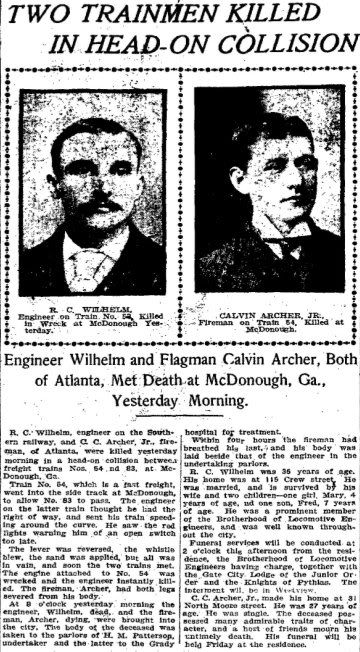
Two Trainmen Killed In Head-On Collision
Engineer Wilhelm and Flagman Calvin Archer, Both of Atlanta, Met Death at McDonough, Ga., Yesterday Morning.
AJC - February 3, 1905
R. C. Wilhelm, engineer on the Southern railway, and C. C. Archer, Jr., fireman of Atlanta, were killed yesterday morning in a head-on collision between freight trains Nos. 54 and 83, at McDonough, Ga.

Train No. 54, which is a fast freight, went into the side track at McDonough, to allow No. 83 to pass. The engineer on the latter train thought he had the right of way, and sent his train speeding around the curve. He saw the red lights warning him of an open switch too late.

The lever was reversed, the whistle blew, the sand was applied, but all was in vain, and soon the two trains met. The engine attached to No. 54 was wrecked and the engineer instantly killed. The fireman, Archer, had both legs severed from his body.

At 8 o'clock yesterday morning the engineer, Wilhelm, dead, and the fireman, Archer, dying, were brought into the city. The body of the deceased was taken to the parlors of H. M. Patterson, undertaker and the latter to the Grady hospital for treatment.

Within four hours the fireman had breathed his last, and his body was laid beside that of the engineer in the undertaking parlors.

R. C. Wilhelm was 36 years of age. His home was at 115 Crew street. He was married, and is survived by his wife and two children--one girl, Mary, 4 years of age, and one son, Fred, 7 years of age. He was a prominent member of the Brotherhood of Locomotive Engineers, and was well known throughout the city.

Funeral services will be conducted at 2 o'clock this afternoon from the residence, the Brotherhood of Locomotive Engineers having charge, together with the Gate City Lodge of the Junior Order and the Knights of Pythias. The internment will be at Westview.

C. C. Archer, Jr., made his home at 31 North Moore street. He was 27 years of age. He was single. The deceased possessed many admirable traits of character, and a host of friends mourn his untimely death. His funeral will be held Friday at the residence.